Wednesday, June 20, 2007

Divagations


“Lingerie in the Grass, Alas”

Does literary existence, apart from one, the real one, which is spent in awakening the inner presence of harmonies and significations, take place, in the world, otherwise than as an inconvenience—
So, Stéphane Mallarmé, in Divagations: the author’s 1897 arrangement, together with “Music and letters,” translated by Barbara Johnson (Harvard University Press, 2007). In a sassy tout court “Preface,” Mallarmé calls the writings “journalism,” (wherein, though, one “can’t help throwing toward the light, over the heads of the multitudes, some truths”) and insists: “This is a book just the way I don’t like them: scattered and with no architecture.” And, perpetually dodging: “One always has the excuse, through all this chance, that any coherence found in the book was aided by its assembly, and perhaps, too, by always saying the same thing.” I like that. I like that nonchalance kowtowing to genius.

I must’ve dawdled a little with Mallarmé’s prose—whatever I found—in my mingy incorporal nether-history somewheres, and Olson too. (One pleasant task is constructing sentences—and if, a tail be needed for a dog-shaped horse, I supply it pronto, even though it make the horse bark.) (Now I need a minute to fossick in the Olson indexes: the man, accordingly, never breath’d a whit of Mallarmé.) It’s the chop—I admit it—in the water here (end of “Crisis of Verse”) that made me think of Olson (I keep thinking about Olson, he’s “nearby”):
Verse, which, out of several vocables, makes a total word, entirely new, foreign to the language, and almost incantatory, achieves that isolation of speech; negating, with a sovereign blow, despite their repeated reformulations between sound and sense, the arbitrariness that remains in the terms, and gives you the surprise of never having heard that fragment of ordinary eloquence before, while the object named is bathed in a brand new atmosphere.
Okay, I admit it, it’s only the preponderance of virgules that Olson’d it. Tempt’d I am, to do it up like an exegete with half-bracket’d lexia and ponderous citations, wha? And then, thinking about lexia versus the exegetical phrase—I’m coasting here—going along with mere brash in my engine—I recall how Barthes admitted it (parenthetically, sotto voce, in Balzac’s hearing, that social climber!): “Literature is an intentional cacography.” (Where’d my Urquhart Rabelais go anyhow?)

The Mallarmé: “Verse” (in French) is always the line. Mallarmé’s seeing the “unit” as the line—“incantatory” (music) and “speech” (speech)—he’s the French Zukofsky—poignant, absolute, avant la lettre. (Note for investigators: What did Zukofsky say about Mallarmé?) Every line is a neologism, or a universe, one-line’d. Mallarmé didn’t cotton to no “poèmes en prose” though he admired nutty William Beckford’s Vathek and he of the “vision of untroubled uprightness” Charles Baudelaire (who “contemplates, alone, in the proud billowing fold of consequences, the Monster-Who-Cannot-Be! Fixing on its flanks the wound of a look both affirmative and pure.”) (Mallarmé also admired nutty Loie Fuller—“insofar as she spreads around her the fabrics she then brings back to her person, through the actions of dance, everything has been said, in articles, some of which are poems.”) And then there’s the matter of the pieces (in prose) collect’d here under the title “Anecdotes or Poems.” Which not infrequently erupt oddly enough, tossing out M.’s own lyrical nuttiness: “—You meanie, you often say naughty things.” Or, “The full stop is measured by the cadence of my determination.” Or, “I am racked with contradictory states, pointless, distorted, and affected by the contagion, the shiver, of some imbecilic ebriety.” (Rhymes with yesterday’s Dawn Powell (nutty Dawn): “I like the way everything looks so crazy when you aren’t drinking.”)

Point is, the talk about “negating . . . the arbitrariness” in that “several vocable’d word” (or “total word’d line”) is posit’d against itself—the “brand new” (the new is always arbitrary). Even Mallarmé’s lingo betrays the clash: “surprise” versus “ordinary.” Upper limit, lower limit. We bathe still in that exact fuddled atmosphere. Musicking the colloquy.

Too, there’s the “Capsule Sketches and Full-Length Portraits.” Villiers de l’Isle-Adam, Verlaine, Rimbaud, “Tennyson Viewed from Here,” Poe, Whistler, Edouard Manet, Berthe Morisot. In the piece about Rimbaud, written in April 1896 for one Harrison Rhodes, editor of a North American journal call’d The Chap Book Mallarmé point’d to “a mysterious something about him either proudly or meanly flaunted, that recalled a daughter of the people, and his laundrywoman appearance, because of his enormous hands, reddened with chilblains resulting from rapid changes of temperature, which might have indicated even more terrible jobs, since they belonged to a boy” and chided purveyors of “cheap anecdotes.” Hands: how disappointingly chubby Frank O’Hara’s look. How Malcolm Lowry hated (and hid) his. Isn’t there a whole missing history of writers’ hands? “Signifying monstrances.”

Gobs of Spicer in the choosing, “nul ptyx” in the means, that rockin’ “Insolite vaisseau d’inanité sonore,” yo: “. . . following the same instinct for rhythm that chose him, the poet doesn’t forbid himself from seeing a lack of proportion between the means unleashed and the result.” And, one adds, prodding that lack up into a fury, an exult, an insobriety, a flood! (In “The Demon of Analogy” Mallarmé notes how he’s assault’d one day by “haunting and accursed fragments of an absurd sentence”:
                        The Penultimate

                Is dead
Like that. And bravely, heroically, futilely, fights it—“I took a few steps down the street and recognized in the “nul” sound the tight string of a forgotten musical instrument, which glorious Memory had just revisited with its wing or its palm, and, putting my finger on the secret behind the mystery’s artifice, I smiled and pleaded, with all my intellectual wishes, for a different speculation”—to no good end. “Then I fled, strange person, probably condemned forever to wear mourning for the inexplicable Penultimate.”) Strange person. Aboli bibelot.

—

Faulkner, in 1926 (Soldiers’ Pay): “Only the ageing need conventions and laws to aggregate to them-selves some of the beauty of this world. Without laws the young would rieve us of it as corsairs of old combed the blue seas.”

Loie Fuller, “La danse blanche”

Tuesday, June 19, 2007

“Metaphor, metaphor, metaphor . . .”


Lichen and Plank

I note that I ’s so “took” by the Merce Cunningham line about movement that I bleat’d it forth double-entry style, one credit, one debit, spanning two days. Which being which, aucune idée. Damnably hot hereabouts, as if to say That explains it. Nothing is ever explain’d—it is only ever “related.”

—

I see that Charles Wright’s Littlefoot is out, a single poem in thirty-five parts—the final excursion an unmusick’d iteration of Alvin Pleasant “A. P.” Carter’s terrific song “Will You Miss Me When I’m Gone.” (I hear Wright saying, “I’d never seen anybody do that before, so I thought I’d see what it look’d like”—or some such—what he reply’d to a query about using one singly Italo Calvino Invisible Cities quote twice, for two parts of China Trace.) Carter:
Perhaps you’ll plant a flower
On my poor, unworthy grave,
Come and sit alone beside me
When the roses nod and wave.
I love to see “Notes”—who’s reading what, what the triggers be. (Habitual with Wright, I think, starting with Bloodlines? Full steam, certes, by The Southern Cross, and in what book the lovely photograph of all the postcards—mostly paintings—tack’d in the gazing space above a desk, Sudek, Morandi, Twombly, Blake.) Here, The Nag Hammadi Library, Wang Wei, Wallace Stevens, Guiseppe Ungaretti, Bob Dylan, W. G. Sebald. The Ungaretti I know: Wright mark’d it (cherish’d it, talk’d it up) for difficulty of translation:
Mattina

M’illumino
d’immenso
And Wright, towards the end of Littlefoot, after noting “Shadows like Franz Kline from the spruce trees” (a “relating”: Elaine Equi’s line about Martha Graham—“With your spooky / Franz Kline make-up”) and picturing a late Orpheus “blue-tongued and pale head behind on the slow Rivanna, / Bumping from snag to sandbar, but singing, still singing”—after that and a whole blast’d ache of slowly expell’d inevitable ceasing—writes:
I empty myself with light
Until I become morning.
A full circle, plain and empty. I love to think, too, how for years now (source completely gone) I’ve protect’d my belief that the Ted Berrigan poem call’d “Matinee” in the Collected is Berrigan’s version of Ungaretti’s “Mattina”:
Morning
                (ripped out of my mind again!)
An intelligencer’s impetus for it being so add’d by the placing (in “Life of a Man”) of a poemlet, “On the Road Again,” dedicated to Ungaretti. I did, I recall, make a stab at translating the thing myself—something like:
Morning

Out of here, big light—
I’m an incendiary device!
I did pull out an paper acids-burnt manila folder of old drafts and rustle about in it for some shuddery moments. I got skeert off by my own dull obsessing (“Death is something of an undertaking . . .” and talk of “something momentous—impinging marriage or squamous death” and “clipped static that sounds like Seurat” and a poem call’d “Putain Kleenex,” ugh.) I did uncover a couple of dandy epigraphs, though: Nabokov’s “The old, old question of Who are you? to one’s own self grown strangely evasive in the gloaming, and to God’s world around to which one has never been really introduced.” And the Dawn Powell thing: “I like the way everything looks so crazy when you aren’t drinking.”

I recall—mid-’eighties—when Charles Wright (b. 1935) went off to China, some bunch of writers, the way they go off in national packs. Wright return’d talking about Jay Wright, also in the group, how they’d hung together. Now winding down, or the Littlefoot author is—“half in love with easeful sleep”—or whatev, is that how it goes? Says, talking about Tao-chi:
                                                          . . . old age
Just recompense for what was not found,
Awaiting the great wash, a “final crash of thunder.”
Says, about writing, words “fixed to music”:
Or so we flatter ourselves,
                                                  sunset cloud tufts briquettes
Going ash in the ash-going sky.
We never look hard enough.
The grasses go back and forth, up and down, for thousands of miles,
But we don’t look hard enough.
I find myself counting syllables, Wright’s admitted propensity for odd number’d syllabic lines, the off-beat hard density of the sole even number’d one here: sunset cloud tufts briquettes, it’s slurry “wash” of sounds.

I recall going up Cayuga Lake in a snowstorm for a Wright reading—someone inexpertly (loudly) popped a beer after we’d arrived, late, spray’d some pedant, got toss’d out, though Wright seem’d happy enough to see us. I recall how, after a reading in the Andrew Dickson White house in Ithaca, early ’eighties, some vaguely punk girl—upstart MFA—on the porch with the smokers, mock’d Wright: doing up a litany of southern highways and rivers. And how first I hated her for it (never hate the young) and next got a whiff of the way aesthetics budge and heave in the sorting. Which is ceaseless, and how dull if everything weren’t up for our moony, misbegotten and wrong’d contention? A little “whole” movement out of the midriff of it:
I love the lethargy of the single cloud,
                                                                      the stillness of the sky
On winter afternoons, late on winter afternoons,
A little fan of light on the tips of the white pines.

I love the winter light, so thin, so unbuttery,
Transparent as plastic wrap
Clinging so effortlessly
                                          to whatever it skins over.

—The language of nature, we know, is mathematics.
The language of landscape is language,
Metaphor, metaphor, metaphor,
                                                            all down the line.

The sweet-breath baby light of a winter afternoon,
Boy-light, half-covered in blue,
                                                          almost invisible as breath,
So still in the flower beds, so pale.
And, next page, talking about a “Chinese principle” of composition, brushwork:
Competent, marvelous, and divine
Were the three degrees of accomplishment.
                                                                               And still, it cannot be done.
How closely the movement—“Metaphor, metaphor, metaphor” to “And still, it cannot be done” mimics what Jay Wright says: how apprehension must needs be “relational,” and how it “has nothing to do with the world.”

Giuseppe Ungaretti and Ted Berrigan

Monday, June 18, 2007

Jay Wright’s Music’s Mask and Measure


Fence and Ribbon

Music’s Mask and Measure, by Jay Wright (Flood Editions, 2007)

I like how—in Jay Wright’s biographical note in Music’s Mask and Measure—he writes that, just after high-school, he “played for two minor-league ball clubs—Mexicali and Fresno—and spent a minute in spring training with the San Diego Padres of the old Pacific Coast League.” It’s that “minute” that thrills me (though the mention of Mexicali, that border town, twinned with Calexico, where I first enter’d Mexico, aimlessly driving the dry hills adds a pleasant memory-smudge). “Minute” is precise with a knowing imprecision, it’s calculatedly inexact in order to draw down the imaginary into it (here, all the lost baseball possibilities—in retrospect, rather laughable, or accept’d—gone in a “minute”)—the word fills up with information a more serviceably “precise” “lexical substitution” (“a few days,” say, or, “one afternoon”) would not allow. My reading of Music’s Mask and Measure is that it is (partially) “about” exactly that kind of substitution.

The book is divided into five parts—titled “Equation One,” “Equation Two,” and so forth. Each part consists of a handful to a dozen short—five or six lines—pieces, untitled, spare, “slant,” often near-aphoristic. The pieces in “Equation Five” are longer, though of similar ilk, and concern. Here, the final two:
All song is bent
by a silent measure;
a dancer’s foot
is a luminous disk in flight.
This song is an open field,
and a fibrous exploration
                where the voice feels braced
by its own fluidity.
We will hope
that this dancer’s body flows
with the expansive ambiguity,
all substance safe, all passion tempered.

                                *

Walking on East Palace,
those who sing find themselves oppressed
by juniper’s shadow.
That sentence is logically true,
if, and only if,
the inoffensive crocodile remains
                a lexical substitution.
The answer lies in carbon-rich clay
and the thin significance
                of the insignificant body.
Say that this relational apprehension
has nothing to do with the world,
or the molecular complexity
of juniper’s shadow,
and that the inoffensive crocodile swims
toward its lexical disaster.
Rife the ambiguities: it’s a poetry that proceeds by churning up possibilities, working the ear for material, or clothing things differently—making stabs at a “relational apprehension” of the world, all the whilst fully acknowledging the impossibility of any complete apprehending. I love the “bent” song “where the voice feels braced / by its own fluidity”—“braced” meaning strengthened, held in, girded up, buttressed, embracing, exhortatory, made brash, all of that—and all of that by “fluidity.” The range of semantic flowering in the relational positing of the three words, voice, braced, and fluidity, is extraordinary, as if the tiniest monocotyledonous grass flower suddenly blowz’d up big as a peony. One is in a world of immeasurable dimensions, with shifts of scale apt to occur with the mere substitution of a word: out of the molecular handiwork of a shadow, all the way out to the “disastrous” stars.

The poems in Music’s Mask and Measure read like distillations, won out of long study, buoy’d up by casual arcana: “tau,” “the attributes of lotus,” Nicholas of Cusa, Seneca, “thermal equilibrium.” The first book of Wright’s (b. 1934) I ever encounter’d (early ’seventies) had to’ve been The Homecoming Singer (Corinth Books, 1971). (“The tart sun, / like a pink six o’clock grapefruit, / bursts over Guadalajara.”) And I’ve kept a ragged lookout over the years—curious about Wright’s reaches down into the belly of esoterica. (And been somewhat overwhelm’d, too, by it.) Here—in the condensare—what Wright calls in the first piece “that stable density of one / and one, the urgent displacement / that nurtures light”—I see a way back, the way late stripped-down works so often point.

Here’s a final three, out of “Equation Two”:
The oriole has established
an evasive coherence,
      infinite, exact
with its place, there where
the day seems set to honor
the bird’s expressive deceit.


Logic always
fails that Carolina wren.
The propositional
exactitude
of a certain absence
draws fire upon its wings.


The bird knows itself a strict
proposal of faith, a ground
state that moves without
an absolute space.
Grammatical bird, attuned
to roots and implication.
Which reminds one of, say, Duncan’s “radicals” or—just encounter’d—Olson’s “roots” in a letter (1954) to Irving Layton, relating how he’d sent some lines to “Bill”—Williams, it seems—about the attributes of what Olson calls “messiness,” though in conjoining it to a notion of Merce Cunningham’s (“the meaning of movement is inherent in its own nature”), it seems to point equally toward “faith,” “origin,” “a ground / state.” Olson:

                                these days

                                                whatever you have to say,
                                leave the roots on.
                                Let them dangle.

                                And the dirt.

                                                Just to make sure
                                                where they come from.
—

Elsewhere.

The sun hung up there too long, getting the look of a dingy slug, something stamp’d out with a punch and pocket’d, carry’d about slapping against a pocket’s truck, jackknife, wingnut, screw. It’s an ancient delivery system—pocketa pocketa—a dynamo, gearings a little rust-encrudded, putting a lopsided throb into its light. Meaning, one thinks, that a large part of the pleasure of reading Faulkner is how it inhabits you, how cleanly it slices in next to the inculpable bone to direct the musculature in its own borrow’d rhythms and sighs. Just to note a concluding—how memory goes with the meat:
But after all memory could lie in the old wheezing entrails: and now it did stand to his hand, incontrovertible and plain, serene, the palms clashing and murmuring, dry and wild and faint and in the night, but he could face it, thinking, Not could. Will. I want to. So it is the old meat after all, no matter how old. Because if memory exists outside of the flesh it won’t be memory because it won’t know what it remembers so when she became not then half of memory became not and if I become not then all of remembering will cease to be.—Yes, he thought, between grief and nothing I will take grief.

Jay Wright

Friday, June 15, 2007

“Gone amoong . . .”


Empty

I went to Olson’s letters to Frances Boldereff looking for Hart Crane—a hunch thwart’d: nothing. And then, the way one puzzles around, scraping little cheek samples here and there, gummy swabs for a “culture”—found Boldereff saying “I love very deeply—the lines at the opening of Call me Ishmael. Are they early Swedish?” Oddly rhyming (to the point of the mimick’d lack of majescules in the titular me) with Susan Howe’s query to George Butterick (in Stephen Collis’s Through Words of Others):
Someday I would like to know where he got the epigraph to Call me Ishmael
O fahter, fahter,
gone amoong

O ees that loke

Loke, fahter:
Your sone!
It haunts me.
(The original’s got “O eeys that loke” . . .) And Olson’s offhand’d reply (to Boldereff):
They are Early olson
                                        Do you know V Bérard on the Ody-
                                        ssey?           is the frobenius of same
Referring to Victor Bérard’s Did Homer Live? (English’d in 1931), a book the original pissaint scrapper (and eye-scratcher) Edward Dahlberg’d recommended to Olson. So: Olson “sone” to “fahter” Melville, that’s one thing. Another is, what plethora (or essais manqués) of epigraphs be gingerly dandled inventions? I recall William Matthews explaining how he “just knew” that somewhere someone’d written something “like that,” and so invent’d one Jean-Philippe Butron, and had him write an epigraph to Matthews’s poem “Becoming a Woman”:
A man writing a poem is speaking to a woman inside him. That explains the common notion that a male poet is lecherous, homosexual or both. Why not say it this way: he wants to be whatever is other: a frog’s tongue, an island formed by a volcano, the opposite sex, someone who loves him, the universe.                                                                                                                                                                        Jean-Philippe Butron
The poem itself is rather negligible: “I feel like / a moon in a sack, a bass / bent against the current like a leer / a dog with a cold rope.” Always loved the Butron though.

—

My strong sense of copycatting thereat proves a dud (I leaf my pages). Though I do come up with the unattributed, italick’d kicker to my longish “For Katherine Yih” (in Rubbing Torsos):
Two plums ripening in a dark room
Or two clouds making galactic noise—any duality beyond
A mere numeral contrapuntal, any complaint
Of this universe.
Though, frankly, typing it—I think its “original” is the five italick’d lines of O’Hara’s “Two Variations”:
Suddenly that body appears: in my smoke
while someone’s heavily describing Greece,
that famous monotonous line feels white
against the tensile gloom of life
and I seem intimate with what I merely touch.
Earlier title: “To Edwin,” dated New York, February 1953. The five lines exist under the title “Poem” a few pages previous to “Two Variations” in the Collected. There’s something thrilling (if fastidious, if “liable to short the circuitry”) about “talking back” to one’s own epigraph. (A variation: the circuitry available for frying a red hot synaptic wire or two by writing a poem call’d “A Poem Beginning with a Line by John Latta.”) (I mean if you be me.)

—

One obvious volume to examine: Doubled Flowering: From the Notebooks of Araki Yasusada, edited and translated by Tosa Motokiyu, Ojiu Norinaga and Okura Kyojin. I clap my hands—three thunderous blows—and it slides out of my bookshelf (it’s misfiled in the J’s for reasons unbeknownst, right next to Laura Jensen’s Bad Boats) and, vertically and noiselessly flying to within inches of my opticks and, with something like a Jane Avril skirt-hiked leg-kick, saucily opens to its epigraph. What is there: an “undated entry, in looseleaf, found inserted into a copy of Origuchi Shinobu’s Book of the Dead,” by Araki Yasusada himself:
In this novel before me there is a painting in a book the protagonist is reading, in which a woman holds a mirror. Behind the reflection of her face is the reflection of a mountain, made tiny by the distance. I wonder what she could be thinking, thinks the protagonist, looking up from the book. I wonder what is happening on the hidden face of that mountain in the mirror . . .
A sort of rogue Borges engorged. Juggling forks. (Is it of any import to know that Book of the Dead is Shisha no sho in Japanese? Sheesh, is something “hiding” there?

—

I’d intend’d something completely different. A kind of squalid wail about Olson, the morass of Olson. Because looking into the letters that’s how it seem’d, as if I were being pull’d down into a suckhole, entrant to a fiery cave of capital dimensions, throwing off sparks into tinder ungatherable. One supposes it’s simply the tender heart of the “archive” beckoning, all the ways that the “chase” is never linear, always a spheroidal explosion, continuous, with each particle thrown off exploding ad perpetuum. Victor Bérard (in 1929) retracing proposed routes of Ulysses in The Odyssey, identifying the fictional stops. Another morass. Olson saying Merce Cunningham’s saying “the meaning of movement is inherent in its own nature”—that’s the archive too.

Jane Avril

Thursday, June 14, 2007

Partial, Vaporous


Bank, Abandon’d

No incompetent misreading contretemps, “pal.” Any mention of competence assumes dynamics operable only in a groupuscule; an isolated competence is, by definition, meaningless. Of course one slings it negatively (insert obligatory “duh” for the comedic “set”); to sling it at all reeks of “standards”—toeing the line, or not toeing the line, same diff (which does not mean même combat).

—

Funny how what’s pertinent arrives (a gratuity, a fortuity) to plug the breach (to patch the britches). Scoop’d up today (out of the ragman’s rabble of archives freshly trundled forth) a book by Stephen Collis, Through Words of Others: Susan Howe and Anarcho-Scholasticism (ELS Editions, 2006). Mark Scroggins’d gone to bat for it a couple months back, so I field’d it, a one-hopper. Second laugh-blast in’s many days seeing the cover-image: detail out of a page of Charles Olson’s “annotated copy of Letters of Emily Dickinson, ed. Mabel Loomis Todd.” Scraggly underline to Scholar Dickinson’s line (in a letter to Col. T. W. Higginson), “Meeting a bird this morning, I begun to flee.” With Olson’s scrawl’d comment: “She fled a bird.” The note’s tone a complete mystery—disgust’d, amazed, chiding?—as is its foreseeable use to Olson. Though, in a letter Susan Howe writes to George Butterick, included in a “selected correspondence”—she says of Dickinson: “Olson disliked her.” Butterick’s reply:
Emily Dickinson. I don’t think Olson despised ED. She was just hardly in his ken; not his kin; irrelevant, in important senses, to a young man who had no father’s garden, whose houses were always rented houses. There was something for a young man, an immigrant’s son, coming of age in Depression America, that required a larger life-form than she was able to give, obviously enough. In my own growth, she was something exquisite—but I also needed the thunder and sprawl and rambunctiousness of Hopkins and Christopher Smart. “There is no frigate like a book” is simply not the same as the spermaceti blood-streaked slimy workingman decks of the Pequod. The distillation of ED, no matter it was dew and sparkling and heady as vaporous wine, was insufficient as a role-model.
Butterick broaching class amongst other things. Everywhere a manner’d quietness about class in norteamericano poetry. How’d a cross-map of class distinctions display overlaid against, say, Ron Silliman’s dodgy Manichean categorying? What class is Susan Howe? What class is John Ashbery? Is it arguable that the nineteenth c. hoity-toit New England transcendentalists versus the hoi polloi rabble “elsewhere” continues “even today”—is the unsung story of “our” writing? (Thumbing, I see Collis troubles—in a part of the book titled “A Lexicon”—notions of poetry, property, possession, things approximating, one thinks, class attitudes. He quotes Howe saying “Poetry is never a personal possession” and “Categories and hierarchies suggest property. My voice formed from my life belongs to no one else. What I put into words is no longer my possession.” A slim book liable to point one off dashing—in countless directions. Hauling down—just this morning—the Boldereff / Olson correspondence to see if the big O.’d writ anything therein about Dickinson . . .)

—

And the breech-plug? the pertinency? Collis, pointing to the ways “American anarchism has tended toward the individualist (as opposed to collectivist) end of its ideological spectrum” quotes Melville’s Moby-Dick:
They were nearly all Islanders on the Pequod, Isolatoes too, I call such, not acknowledging the common continent of men, but each Isolato living on a separate continent of his own. Yet now, federated along one keel, what a set these Isolatoes were!
And puts against it “Thoreau’s even slimmer imagination of the possibility of collectivity” (out of Walden):
But for my part, I preferred the solitary dwelling. Moreover, it will commonly be cheaper to build the whole yourself than to convince another of the advantage of the common wall; and when you have done this, the common partition, to be much cheaper, must be a thin one, and that other may prove a bad neighbor, and also not keep his part in repair. The only cooperation which is commonly possible is exceedingly partial and superficial.
“Exceedingly partial,” c’est moi.

Charles Olsion and George F. Butterick, Gloucester, c. 1968
(Photograph by Ann Charters)

Wednesday, June 13, 2007

A Flood


Cattails

Out briefly into the suburb-encroach’d fields, and back in plenty of sunlight. Trying to find a Hart Crane line about “action,” I stumble over: “I think that the artist more and more licks his own vomit, mistaking it for the common diet. He amuses himself that way in a culture without faith and convictions . . .”

How easily and completely I get blown off course—looking for a line about “a dog eating its own vomit” in Charles Wright’s notebooks (found, though not “usable,” not so succinct, nor apt as I’d recall’d), I end up with: “One of the differences between poetry and prose is that—good or bad—lines are final. Sentences are never final, but ceaselessly rearrangeable.”

So I fetch The Grave of the Right Hand, wherein one locates a few Wright prose poems, the only ones I know. Intending to study one, rearrange it, only to note (with a brainpan-rearranging snort) that it’s one sentence long:
Storm

And when, that night, the unseasonable rain (the hail a shredding sound in the lemon trees) thudded against the lumbering of the bay, in August, haunting the dark with a querulous whiteness, he retired to the basement room under the house to study the various aspects of water, the ships in sudden counterpoint on the rising scales of the sea, and to wait for the breakthrough, across the barren hills of his brain, of the bronze soldiers, for the swelling flash of their knives.
                                                                                                                                                                              Positano
Backlit by the Rimbaudesque “savage parade,” methinks: it’s the soldiery that does it.

Okay, for “scientific” purposes (“so I contradict myself”)—three rearrangements of sentences within a paragraph (out of Ron Silliman’s Paradise):
Remember the days when Bob smoked dope all the time? Big slow jet, low over the horizon. I’m impatient that each word takes so long to write. All cotton pleated chino twills. You’re a commie, too. As when, in the newspaper, an article on how to ride a camel brings tears. Her eyes on me wide and brown. Well, Masanori Murakami has been released. Aka will, verb transitive. There is no pain equal to the memory of pain. My life is not your symbol. Historians eke rhyme from fact.

—

Big slow jet, low over the horizon. Her eyes on me wide and brown. There is no pain equal to the memory of pain. I’m impatient that each word takes so long to write. As when, in the newspaper, an article on how to ride a camel brings tears. All cotton pleated chino twills. My life is not your symbol. Historians eke rhyme from fact. Aka will, verb transitive. Remember the days when Bob smoked dope all the time? Well, Masanori Murakami has been released. You’re a commie, too.

—

Well, Masanori Murakami has been released. Big slow jet, low over the horizon. My life is not your symbol. Her eyes on me wide and brown. You’re a commie, too. There is no pain equal to the memory of pain. As when, in the newspaper, an article on how to ride a camel brings tears. Aka will, verb transitive. Historians eke rhyme from fact. All cotton pleated chino twills. Remember the days when Bob smoked dope all the time? I’m impatient that each word takes so long to write.
Effects of rearrangement mostly local. The tiny twitters of the (various) affect-inducements of (various) juxtapositions differ (variously, locally) in kind, not in degree. The overall disjunct-patter pattern—picture an array of points, comic-tragic along the x-axis, human-inhuman along the y-axis, spattering out into the four quadrants—is going to elicit (generate) a similar line (hyperboloidal or whatnot) no matter how the sentences are arranged. With a bigger sample, it’s likely one could imbue an arrangement with elements of conventional narrative. (Here’s where, as in that “little screen” production of the ’fifties or ’sixties—what’s it call’d, You Be Somebody?—the emcee asks for the real Ron Silliman poem to please stand up and, amidst highly-coach’d feints and pauses and g-g-good-humor’d tomfoolery, one of the contestants finally (almost bashfully) does so. “Number two? oh, I was absolutely positive it was number one.” Who turns out to be a laundress in Teaneck.)

—

Hart Crane writing to Waldo Frank (1926):
The validity of a work of art is situated in contemporary reality to the extent that the artist must honestly anticipate the realization of this vision in “action” (as an actively operating principle of communal works and faith), and I don’t mean by this that his procedure requires any bona fide evidences directly and personally signaled, nor even any physical signs or portents. The darkness is part of his business. It has always been taken for granted, however, that his intuitions were salutary and that his vision either sowed or epitomized “experience” (in the Blakian sense). Even the rapturous and explosive destructivism of Rimbaud presupposes this, even his lonely hauteur demands it for any estimate or appreciation. (The romantic attitude must at least have the background of an age of faith, whether approved or disproved no matter.)
Typing that, I begin to suspect that there’s some Christian meaning to “action” (good works) that is slapping at Crane’s fanny (and “unavailable” to me). I am trying to correlate “action” here to Jackson Pollock’s “procedural” term, working in the painting. Pollock:
When I am in my painting, I’m not aware of what I’m doing. It is only after a sort of “get acquainted” period that I see what I have been about. I have no fear of making changes, destroying the image, etc., because the painting has a life of its own. I try to let it come through. It is only when I lose contact with the painting that the result is a mess. Otherwise there is pure harmony, an easy give and take, and the painting comes.
Which, in counterpoint, to the Crane, suddenly betrays a similar “religious” thrust, a submerging of self in the demands of “works and faith.” Less a procedural commitment than a tenacious human drive to subsume oneself in something larger—“experience” (of whatever sort). Is that “available” through unfinal “ceaselessly rearrangeable” sentences? It may well be. (My sense is that Crane’s “The darkness is part of [the artist’s] business” and Pollock’s “I’m not aware of what I’m doing” are absolutely key to the activity—that “submergence” again.) Subjectivism: the human being subject of the work through being subject’d to by the work. (How much is the reading of Faulkner’s unbelievably powerful manhandling prose—about the “tall convict” swept along for days in a skiff in a flood—in The Wild Palms pushing me into the morning’s “do me, Lord” version of art, I do not know . . .) Think I’ll jump ship with a critic—Harold Rosenberg’s assessment of “Action Painting” (with bonus words for “our” groupuscules):
In that it dared to be subjective, to affirm the artist as an active self, Action Painting was the last “moment” in art on the plane of dramatic and intellectual seriousness. The painters in this current have kept to the tradition of the human being as the ultimate subject of painting. All art movements are movements toward mediocrity for those who are content to be carried by them. The premises of Action Painting, however, are still valid for individual beginnings.
Out of the essay “Action Painting: Crisis and Distortion” (The Anxious Object).

Ron Silliman and Charles Wright

Tuesday, June 12, 2007

Pee in the Cereal


Iris

Leave it to the age of rampant (Republican) “standards” testing (partout, the schools, in particular, riddled with it) for poets to begin talking about “competence.” More of the addled “scientism” of letters. (Fits precisely with the statistical (rarely) or merely numerical approach Ron Silliman substitutes for the harder thinking of source and effect and meaning: trotting out some numbers no matter what the reputed bug under the lens always looks like “measured consideration” no matter how hideously inappropriate.) My druthers—when it comes to poetry—is for the sprocket’d badinage and viscous bave-drool bavardage of the idiot: go measure one single string of sputum dangling off that lip. It’s astonishingly elastic, it’ll zip up again like a yoyo. One nudge, it retracts in denial like a snail’s antenna. Immeasurable, incontinent, incompetent. Or my druthers is for the fleet animadversions of the crank’d street soloist hustler. Measure that hurlage in a “timely” manner—that is, with the “instruments” of the “era.” Never forget Coleridge: “No work of true genius dares want its appropriate form, neither indeed is there any danger of this.” He continues, suggesting what’s necessary is that one proceed under “laws” of one’s own. Which, by any definition, means “incompetently.” Unsuitably.

—

Hart Crane: “The function of poetry in a Machine Age is identical to its function in any other age; and its capacities for presenting the most complete synthesis of human values remain essentially immune from any of the so-called inroads of science. The emotional stimulus of machinery is on an entirely different psychic plane from that of poetry. Its only menace lies in its capacities for facile entertainment, so easily accessible as to arrest the development of any but the most negligible esthetic responses.” Which is approximately where “we” be today, stuck in the burgeoning land of the poetry of arrested development. (Jennifer Moxley nails the “phenomenon” in her wonderful fifty-ways-aphoristical chapbook “Fragments of a Broken Poetics” (Impercipient Editions, 2006): “Poets whose readings lead us to believe ourselves part of a spontaneous and instinctive consensus have left poetry behind. Perhaps for the better.” That acid tag “Perhaps,” its left-handed poke into the rah-rah oblivious . . . One other to note—I cannot help it: “The idea of audience is a nuisance born of the need for spectacle. Poems haunting the precarious dialectic between existence and extinction do not need it. Their magic is dependent on the private experience of separate individuals.”)

—

The menace of “facile entertainment”: see today’s gee-whiz hoo-hah guffawing techno-gizmo kids. Little to nothing and nowhere pointing to, oh, the Gitmo kids, the dead kids, the unleash’d careless roars . . . No, “appropriate” (thieve)—the poets say—and “be inappropriate” (childish, stupid, “I call him Vladimir”)—more aping of the Bush Age’s dopey indifference coupled with rampant avarice and cupidity. It is not charming.

—

For Crane on “competence,” see the line about Whitman: “His faults as technician and his clumsy and indiscriminate enthusiasm are somewhat beside the point.” And if one peruses Crane with a tender and patient eye—an eye I, for one, am not unfailingly equip’d with—, one’d say the same:
The nasal whine of power whips a new universe . . .
Where spouting pillars spoor the evening sky,
Under the looming stacks of the gigantic power house
Stars prick the eyes with sharp ammoniac proverbs,
New verities, new inklings in the velvet hummed
Of dynamos, where hearing’s leash is strummed . . .
Power’s script,—wound, bobbin-bound, refined—
Is stropped to the slap of belts on booming spools, spurred
Into the bulging bouillon, harnessed jelly of the stars.
Preposterous stuff. (Lines out of “Cape Hatteras,” being the fourth part of “The Bridge.”) Monstrous metaphorical mash-ups forcedly made. Laughable impossibles under a wholly un-ironic sun. Writ under the grimace of the attempt’d true’d, a damnation to put it down right, the country busting forth into its initial phases of gigantism. A nigh-imbecilic “project.” Though: what other norteamericano poet ever caught the early twentieth-century mix of stratospheric aims and grit industrial spunk, yearn and leash, jelly and spoor, the sense-addling stink of “progress”? Think bridge, dam, depot, pylon, skyscraper. (Today, that gigantism’s gone off haywire, think of the gigantism that island species—lacking predators, all constraints removed—exhibit. Think of some of today’s norteamericano poets as ectothermic megafauna, cold-blooded, saurian.)

—

Ah, vitriol. Sleepless, turn’d to the Faulkner. He’s got it, of love continuing through habit, lives adjusting to the stark adamant demands of merely getting by, sour’d by routine bourgeoisesqueries, a man says (The Wild Palms): “I realized what we had got into, that the starving was nothing, it could have done nothing but kill us, which this was worse than death or division even: it was the mausoleum of love, it was the stinking catafalque of the dead corpse borne between the olfactoryless walking shapes of the immortal unsentient demanding ancient meat.” Whoa.

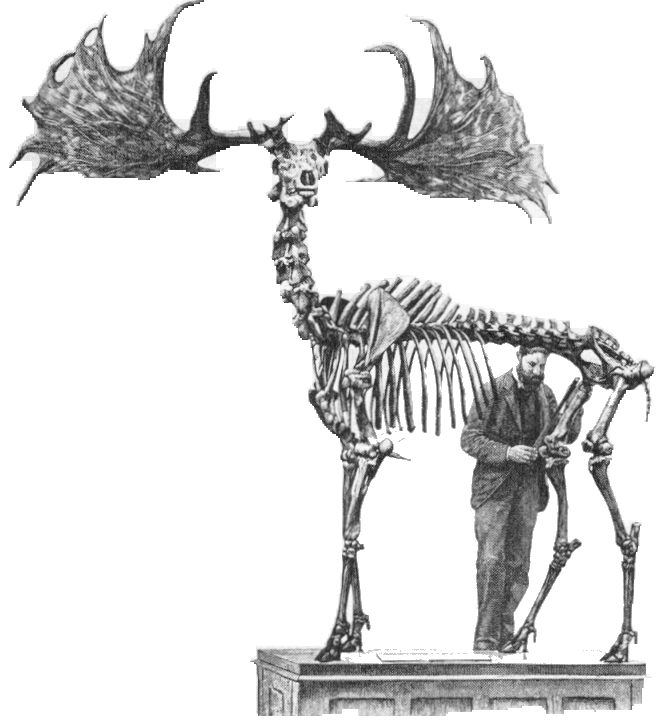
Irish Elk (Megaloceros giganteus)

Monday, June 11, 2007

Wild and Precise


A Barn

Likely bass under-throb to the summer: Rabelais. It is the book—I snicker to admit—of regularity, tempo-thud, low-ghosting counterbeat to the skittish traps. Lesser, meaning “shorter,” flights’ll interrupt it—and must, for the pleasure of the turning back. As Gargantua puts it: “There is no need of wiping one’s tail . . . but when it is foul; foul it cannot be, unless one have been skiting; skite then we must, before we wipe our tails.” (Skite: out of the Old Norse skíta “to void excrement,” in The Flyting of Dunbar and Kennedie (1508), one plugs the other with “Skyttand skarth, thow hes the hurle behind.”) All—in the Rabelais—a wee meagre serving of what Grangousier labels “this torcheculatife, or wipe-bummatory discourse,” and (“prythee”) prods the big G. to continue. Who dislodges pertinently:
Afterwards I wiped my tail with a hen, with a cock, with a pullet, with a calf’s skin, with a hare, with a pigeon, with a cormorant, with an attorney’s bag, with a montero, with a coif, with a falconer’s lure. But, to conclude, I say and maintain, that of all torcheculs, arsewisps, bumfodders, tail napkins, bunghole cleansers, and wipe-breeches, there is none in the world comparable to the neck of a goose, that is well downed, if you hold her neck betwixt your legs . . . for you will thereby feel in you knuckle a most wonderful pleasure, both in regard of the softness of the said down, and of the temperate heat of the goose, which is easily communicated to the bum-gut, and the rest of the inwards, in so far as to come even to the regions of the heart and brains.
(Montero: “Spanish hunting cap, with a spherical crown and (often) fur-lined flaps able to be drawn down to protect the ears and neck.” Torchecul: “burn-butt.”)

—

The latest excursion—dashing off in a Hooker green fit of what? botanizing?—Faulkner’s The Wild Palms. Because Kundera point’d at its oddball form—two different stories intertwining, sharing little beyond the book’s spine, and a meaty grimness? Because one thinks one’s “read” Faulkner, and it turns out that’s probably not exactly so: one recalls Sanctuary (the one Faulkner claim’d he wrote because “I wanted to buy a horse and I thought that people made money writing books, so I wrote a book to make enough money to buy that horse”—oh, for the days of blunt answers, long before the various kinds of capital—cultural, academical, snobismical, mescal—muddy’d the puddle) and Light in August (Joe Christmas), both, one thinks, pastimes of a Charlottesville spell of quitting smoking, or quitting drinking, or both, a pastime no different in the cross, jumpy, beleaguer’d circumstance of fighting with one’s grimace-faced needs and howling compulsions than getting in the Subaru Brat and driving up over the mountains to Waynesboro or Harrisonburg, aimlessly stopping in junk shops, or at trail heads (to hike out additional aimlessness), or down two tracks to small bodies of water to throw out a line, or plunge in for a dip. Strict pedantic blind-eyed avoidance. The paranoia of resuming anything like a routine, one particular unshakeable routine. So: books reduced to temporary surface eddies of meaning, soonest swept under. (Or, it is always like that, how little one “recalls,” only then the nicotine fidgets exacerbated it.) Now I read The Wild Palms deafen’d by sentences, under-roil and tensile surface clatter too:
It was as if the water itself were in three strata, separate and distinct, the bland and unhurried surface bearing a frothy scum and a miniature flotsam of twigs and screening as though by vicious calculation the rush and fury of the flood itself, and beneath this in turn the original stream, trickles, murmuring along in the opposite direction, following undisturbed and unaware its appointed course and serving its Lilliputian end, like a thread of ants between the rails on which a express train passes, they (the ants) as unaware of the power and fury as if it were a cyclone crossing Saturn.
There’s something potable there, sentences I read with a sharp intake of breath—impeccable rhythms carry’d out into long, impossible long, tensile extensions without snapping, without needing to snap. (Maybe I only ever read for that—hence the lost books.)

—

I rarely leaf through the magazines, though I found myself with a New Yorker propped up next to my bowl of oats today, darting my optics at it. Found (in an article by one D. T. Max about the deposit of writers’ archives in the Ransom archives in Austin, Texas) a line out of a letter by Don DeLillo (to David Foster Wallace). DeLillo talking about the way he writes prose being trigger’d by “a sensitivity to the actual appearance of words on a page, to letter-shapes and letter-combinations.” Though he continues (in a manner I find rather contradictory):
At some point (in my writing life) I realized that precision can be a kind of poetry, and the more precise you try to be, or I try to be, the more simple and correctly responsive to what the world looks like—then the better my chance of creating a deeper and more beautiful language.
Capturing the precise look of the world is not equal to making a “good-looking” page of words. The reason, though, I note it, is that I’ve never seen any writer admit to such malarkey. It’s always “sound.” Nobody ever says, “his” is such an ugly word—I refuse to use it. Or, I put “Nijinsky” in because that row of dottings makes my heart beat fierce as a goon. (Foster Wallace quips back: “I found your comments on the physical architecture of clauses and words and letters real interesting and yet identified with them not one whit. I think I’m maybe 100% aural. My eyesight’s really bad anyway.”)

—

First swim of the summer (Sunday). Pleasant local patches of minor burn—muscle burn, skin burn. That deep pulse of activity running down into the body’s serest thickets, tiny inner aquifer release and leveling, dispelling “haunts.”

William Faulkner, 1897-1962

Friday, June 08, 2007

Tin Can


A Ditch

The humidity’s tonguing everything, getting tongues wagging, you know the way people talk. And nothing accomplish’d in the interim, one’s got to make it up in situ, hazardous-acclamatory style. I did snooker home with the newish Library of America Hart Crane—I never decide if Crane’s an embarrassment to the “clan” or a thief of’s own riches. Example: amidst the “unpublished poems & fragments” I lit briefly on “Lenses”:
In the focus of the evening there is this island with the buzz of saw mills, the crunch and blast of quarries; furnaces, chisels and ploughs.

And the idiot boy by the road, with carbonated eyes, laughing or extending a phallus through the grating,—talking to a kite high in the afternoon, or in the twilight scanning pebbles among cinders in the road through a twice-opened tomato can.
Bottom of page. I consider’d it complete, a sketch, a sort of spatial shift “worlds in the whorl of a fingerprint” percept, liked the “carbonated,” query’d the “twice-opened” (a little imprecise, literary). Turn page—turns out there’s more—“And there is work, blood, suet and sweat,—the rigamarole / of wine and mandolins . . .” The incipient tendency to explicate, to provide a consider’d “meaning” to what he’s up to—and worse, what’s prose becomes lineated, in—narrowing to handle-sized—the calligrammatic shape of a magnifying glass, what field biologists call a “hand lens.”

The casual industry of skimming and alighting: turns out there’s a poem “about” that same boy in Crane’s gathering “Key West: An Island Sheaf”:
The Idiot

Sheer over to the other side,—for see—
The boy straggling under those mimosas, daft
With squint lanterns in his head, and it’s likely
Fumbling his sex. That’s why those children laughed

In such infernal circles round his door
Once when he shouted, stretched in ghastly shape.
I hurried by. But back from the hot shore
Passed him again . . . He was alone, agape;

One hand dealt out a kite string, a tin can
The other tilted, peeled end clamped to eye.
That kite aloft—you should have watched him scan
Its course, though he’d clapped midnight to noon sky!

And since, through these hot barricades of green,
A Dios gracias, grac—I’ve heard his song
Above all reason lifting, halt serene—
My trespass vision shrinks to face his wrong.
I rather think: spit it out, Crane! What’d seem’d direct and swift and apt is tottering through an upheaval of “literature,” no? “Carbonated eyes” become “squint lanterns”; the lovely “extending a phallus through the grating”—wherein the boy’s member becomes a kind of zoo-animal—almost completely disappears: “likely / Fumbling his sex.” A particular mess with that “One hand dealt out”—an act that’d seem to require two. And a complicated “exegetical summing up” interposes its grubby fist at the end: here, the tin can seems “once-opened,” that is, if the boy “clapped midnight to noon sky”—a necessary literary night—it must be because there is but one “peeled” (imprecise) “end.” (There’s a whole ’nother thing starting up in the words “trespass” and “shrinks”—Crane’s push-pull sense of fascination and violation, unexplored.)

Third exhibit. Sensing that pull in Crane, I pour’d my tired lanterns throughout the letters, help’d—I add—by the fact that the unpublish’d piece is dated “c. 1926-27.” Sure enough: in a letter to Waldo Frank, datelined “Nueva Gerona, Isle of Pines, Cuba, August 19, 1926” one reads:
I have made up a kind of friendship with that idiot boy, who is always on the road when I come into town for mail. He has gone so far as to answer my salutations. I was unexpected witness one day of the most astonishing spectacle; not that I was surprised.—A group of screaming children were shrieking about in a circle. I looked toward the house and saw the boy standing mostly hid behind the wooden shutter behind the gratings; his huge limp phallus waved out at them from some opening; the only other part visible was his head, in a most gleeful grin, swaying above the lower division of the blinds.

When I saw him next he was talking to a blue little kite high in the afternoon. He is rendingly beautiful at times; I have encountered him in the road, talking again tout seul and examining pebbles and cinders and marble chips through the telescope of a twice-opened tomato can. He is very shy, hilarious,—and undoubtedly idiot. I have been surprised to notice how much the other children like him.
In the looking for that, stumbled on a few lines written just a month or so earlier—to William Wright—where Crane complains about the work of writing (and largely expresses my troubled sense of the result). He’s envying those “who have intensive work to do without having to wrestle with either angel or devils to continue with it”—and says:
I get awfully exhausted sometimes, trying to achieve some kind of consistent vision of things. But I don’t seem to be able to relax—and knowing quite well all the time that most of my energy is wasted in a kind of inward combustion that is sheer nonsense. All else seems boresome, however, so I must continue to kill myself in my own way.

Hart Crane

Thursday, June 07, 2007

Bookish


A Hole

Books pile up. Some I forget about, second-hand things scoop’d up out of book mischief, the way a book’ll beg like a starlet for one chance to expose itself (with a shimmy, a lark, a pout), and end up an untoward necessity, never entirely ditch’d. (The way a sentence’ll beg like a stray dog for one chance . . . oh stop.) And going about shifting piles here and there, one uncovers things: landscapes of a soul. (The idea coming out of Stendahl, who got replaced by Rabelais, who got replaced by Kundera, who . . .) In the Henry Brulard, he writes of “Landscapes . . . like a violin bow playing on my soul” and longs to specify a landscape for each acquaintance: “the line of rocks as one approaches Arbois . . . and coming from Dôle along the main road, was for me an obvious and perceptible image of Métilde’s soul.” One uncovers things: a fortuitous inventory of a particularly rabid few months, the lowland scrapings of a mined-out region, unconditional hazards, bullies with spines, dog-ear’d replicas of gone days, double-shelved wonders. Upshot of living in semi-detached chaos: even if I never locate, say, my copy of The Sinking of Odradek Stadium, one day a Penguin Herodotus’ll spurt forth out of the turbulence, or one day a 1965 California paperback of Hart Crane’s letters—edited by Brom Weber and since, I think, “superseded”—full of curious markings made, according to one note, by one Susan Jenkins Brown, to whom Crane sent several letters. Identifying initials and ellipses provided in a minuscule blue-ink’d hand. In pencil—on the first (blank) page: “For Bernard Magda, Christmas, 1967.” Or a knowing note addressed to one (or two) “Finches,” in a cramp’d hand:
These initials and blanks of Weber’s blow up this incident disproportionately. There was nothing sinister about it at all. Hart was trying to be coy and funny. Sue.
The “incident” is hardly count’d one: most of the blanks refer to one “incomparable Jack,” a “noble tar” who “comes clear up from Norfolk” (to Patterson) to see Crane. Elsewhere, pointing to Crane’s report of “a wild Irish red-headed sailor of the Coast Guard” who “took me to some kind of opium den way off, God knows where. Whereat I got angry and left him, or rather Mike Drayton did,” Brown writes in the margin:
Hart said he used the name of the 16th cent. poet Michael Drayton when he went prowling, drunk, to sailors’ hangouts.
A lovely detail. The Drayton of the Poly-Olbion, that topography of England, what seems to upstart aerially:
Direct my course so right, as with thy hand to showe
Which way thy Forrests range, which way thy Riuers flowe;
Wise Genius, by thy helpe that so I may discry
How thy faire Mountaines stand, and how thy Vallyes lie;
From those cleere pearlie Cleeues which see the Mornings pride,
And check the surlie Impes of Neptune when they chide,
Vnto the big-swolne waues in the Iberian streame,
Where Titan still vnyokes his fiery-hoofed Teame,
And oft his flaming locks in lushious Nectar steepes,
When from Olympus top he plungeth in the Deepes:
That from th’Armorick sands, on surging Neptunes leas
Through the Hibernick Gulfe (those rough Vergiuian seas)
My verse with wings of skill may flie a loftie gate . . .
A sailorly piece. How did I find myself here?

Thinking of something like a lost capacity for the Imaginary. Thinking the Imaginary is always and ever now mere pendent to the small lost dogs of Hearsay. The ab ovo Imaginary bust’d, in pieces. Milan Kundera writes about one Kazimierz Brandys, in whose Pomysl (Idea) one finds the story of a Polish émigré teaching the history of Polish literature at an American university: “knowing that no one has any idea of it, he invents for his own amusement a fictive literature, made up of writers and works that have never existed.” (Upshot is, the literature “differs in no essential way,” invention merely apes the real.) Or there’s the story Herodotus tosses forth: of one Psammetichus, a king of Egypt who insist’d that of all the races in the world, the Egyptians were the most ancient. Prodded to a proof, he puts two newly born babies out amongst the sheep, instructs the shepherds to bring them up, offer them goat milk, keep them isolated in a “lonely cottage,” &c.—and to utter no word in the tykes’ presence. “All these arrangements were made by Psammetichus because he wished to find out what word the children would fist utter, once they had grown out of their meaningless baby-talk.” Two years later: the shepherd enters the cottage and “both children, running up to him with hands outstretched, pronounced the word ‘becos.’” Phrygian for “bread,” Psammetichus wrong, other versions of the story have the kids raised by women with tongues cut out, it’s all and ever Hearsay, nothing is ever invent’d, there is no Imaginary. Books pile up.

And authorial intent? How did I find myself here? Authorial intent is like the Hide-behind in “the wry mythology of the Wisconsin and Minnesota lumber camps” (Borges):
The Hide-behind is always hiding behind something. Whichever way a man turns, it’s always behind him, which is why nobody has ever satisfactorily described one, though it has killed and eaten many a lumberjack.
And many a writer. The only advice I can think of: if you see the Hide-behind of authorial intent coming, find something bigger to hide behind.

Michael Drayton and Hart Crane

Wednesday, June 06, 2007

Benjamin Friedlander’s The Missing Occasion of Saying Yes


Porco con le ali

Reach’d for my neck at the hair-trigger of a something moving there, hand come away with a friable (crummy) miniature black thing (in pieces). No flea’s friable like that. No flea’ll come apart without what one hacksaw it into two halves with a thumbnail. Why the sour-mash colloquial puttin’ its hand in my speech? In the midst of reading the opening piece in Benjamin Friedlander’s brand new collection of early work, The Missing Occasion of Saying Yes (Subpress, 2007). Insanely terrific that title, and a damnably handsome book. About two hundred pages of poems “written between 1984 and 1994,” in four sections—“Emerald City,” “Time Rations,” “Covenant Algebraic Melody,” and “Adventures in the Vernacular.” Complete with an index of titles and an index of first lines. In a perfect smallish format, something like four-and-a-half by seven inches—hand-sized, portable, for use. That first bug-interrupt’d poem:
Emerald City

She bought the boot that kicked the shit
of every blasted empty littered can. Then George
called to say he gave the wrong address for Allston
Way and didn’t make bail. A lay-awake dragweight
          melancholy
rulebound and clock known / compressed of a step
          back through
the tantrum. Chartered roads go there
empty handed and speak through glass
where State of Grace v. Wrecked & Abandoned
Sailing Vessel
would be authority. Argued before the
sleepless
this eventual day of January, 1988.
Forty minutes away by car
&
“money’s only good if you don’t die tomorrow”
All kinds of lingo. There’s “The House That Jack Built” echoing in that first line—a kind of childish glee temper’d with almost blasé despair—that gets interrupted by “Then George . . .” (a smidge less abrupt than “And then went down to the ship”). There’s a kind of long-a keening to “lay-awake dragweight” that slips into spondaic perimeter markers “rulebound and clock known” (wherein one hears, too, lockdown, clipped jail talk). Beginning with “Chartered” the language goes legal, lawyerly, mocks the airs of “would be authority” (with higher authority getting its poke in the ribs—“Grace” and “Vessel”). The doggedness of justice “this eventual day” and street legal demotic proverbial wisdom in the final line—akin to kid-rhyme, circling back to the beginning. There’s a remarkable ear putting that together—too, a condensing intelligence. Encompassing realms and washes in a few lines.

They get smaller. Thumbing around, the way one considers a poet—I’ve known of Friedlander’s poetry for several years without having read much of it, or much of it closely—I think of Dickinson, of Celan (fearless neologizing), maybe a little Larry Eigner, a little less Robert Grenier. Friedlander’s tendency—even in the tiniest pieces—is to complicate and combine, to put things into relation by inextricable (taut, knotty) means, rather than by “mere” juxtaposition of perceived details, or by the decontextualization / recontextualization of sampled speech. The results go beyond the simple ironic gulp / snicker of recognition, and ask a little readerly (or “writerly,” if one’s using Barthes’s nomenclature) exertion. A kind of “value-added” poetry, one’d say in a fiscal fit, rarely “spent” in one brief look. Here’s a small one that strikes a chord with “Emerald City” (perhaps) by being titled “Rulebound”:
one doesn’t change one’s
only mind
so many ways apprised
so little known—so trued—

merely to split worlds
spinning so slowly
my
sweet ablative you
And typing that I think of Olson (“What does not change / is the will to change”) though, oddly enough, there’s likely something of John Donne’s “A Valediction: Forbidding Mourning” in the adamant (moving) stasis here, the way the emphasis is put (daringly, using a rhyme old as water) exactly balanced between “—so trued—“ (the em-dashes serving as pointers) and “you.” Considerable mischief: that “apprised” calling up “prised” (pried off, pried apart) and “prized,” along with “apprehended,” “learnt”—in a sense the line stands for all the poem holds to itself. “Ablative,” the (other) point where the poem’s diction gets its register jolt’d, name of the Latin noun case that expresses such things as direction, cause, agent—ablative’s root pertains to “removal, carrying away.” If echoes of the whole tradition of “pieces for absent lovers” bounce knowingly through Friedlander’s poem (think of Donne’s lines, “Dull sublunary lovers’ love / —Whose soul is sense—cannot admit / Of absence, ’cause it doth remove / The thing which elemented it”), there is, too, an affective mocking of that tradition, trigger’d largely by the change-up thrown by that “ablative.”

I first heard of Friedlander, I think, through Don Byrd, who mention’d (circa 1995) I ought to examine a paper about O’Hara and race—I in the midst of cobbling together a dissertation “about O’Hara.” I think I pegged him (in my brainpan) as O’Hara scholar. Astonish’d, somewhat later, to learn (I must’ve ask’d) that Friedlander was writing about “Emily Dickinson and the Civil War”—that’s how I recall it—for a dissertation at Buffalo. Astonish’d that he’s putting together a book of Olson prose, and Eigner works, and the impeccably ludic provocation of Simulcast: Four Experiments in Criticism, and several collections of poems, chapbooks and up. (Astonish’d to learn just now that he’s putting together a Creeley Selected Poems, 1945-2005 for publication in late 2007.) What I admire: the restlessness, the “expanse” of what Friedlander sees as “fit for inquiry”—if one checks into the manic shutterbugging here, one’ll see document’d, too, amongst much else—overlook’d nineteenth-century women writers, patriotic displays in Bangor, Maine, Poundian archives, Italian political cartoons, Shakespearian actors—an wide-open maw of pursuits. In an era of close-fistedness and intellectual narrowness, there’s something entirely refreshing about Friedlander’s enthusiasm and reach. Against which, that is to say, recognizing the possible dangers of such, the foibles of the “vex’d” and “gaseous” and terribly vexing Mr. Pound, another poem:
Poundian

The first principle of academic cricketism
is expand,
wandering home
gaseous in our anti-chastity

The flimsiest of whistlings
to shiver the saving graces
of the cold damp night
of art
Work done near solely by sound: against the slithering rustle-away of all the s susurrus of “gaseous,” “chastity,” “flimsiest,” “whistlings,” &c., one poses the clarity of the disburden’d “cold damp night”: art.

Benjamin Friedlander

Tuesday, June 05, 2007

To ‘Joyful Irresponsibility’


Grasses

And one day one recognizes the source of the recurrent restlessness: it is the sudden latch into screw-eye—ominous minuscule click—of a reader (any reader) coming in out of the glare of the sun-doused patio, fastening the screen-door behind, swimming brazen-headedly up out of the whited-out morass of “all readers,” (meaning: no readers.) Author of the thunderous ongoing recitatif, the spiv recital, its shill featurettes and occasions, one gathers up the toss’d down reins of one’s restraint, hauls up against one’s recklessness, chomps anxiety’s bitter bit. Is that true? Now that I’ve writ it out large, chemically enabled some kind of sepia’d physiognomy to emerge as if out of the blank page, I am less sure. Replacing the reader with a reader of one’s own making. Everybody cozy now. Audience: It must be abstract. It must change. It must give pleasure. “This is a facile exercise.” (Or, later, one stumbles over a report of Federico Fellini’s later works, post-Amarcord, “antilyrical,” “antimodern,” “disenchanted” with the beastly contemporary world, “no longer obligated to anyone, he savored the ‘joyful irresponsibility’ (his words) of a freedom he had never known before.” Another “reason” for the chameleonic reversibles of the masters: to leave audience in the lurch.

—

The choicest thing: to lose oneself in a bang’d up frenzy of sun, “Washed in the remotest cleanliness of a heaven / That has expelled us and our images . . .” The improvidences of Stevens age for us well, like isometrics, a whole category of self-imposed (self-battling) calisthenics. That plucky willingness to attend to the barely audible: murmurs and proofs of winters and porcelains and Tehuantepec. That willingness to cane away at the implausible, in a regiment’d kind of fuggery for basic unsettlement. Unappeased by objects, always looking to objects (objects tally’d and sort’d like oysters, fines, spéciales, fines de claire, spéciales de claire) for appeasement, a way of getting the world to deliver up in return the countless unaccountable desires one dubs it with. “All sorts of flowers.”

—

Peckish with aesthetic consternation, that’s no way to be. Halt at the hill-brow, a sand ridge, a toy village is out there “in the offing,” a hazard, squarish huts topped off with pure antenna’d bristle. Say it’s a place placeable and history’d, an armature of one’s republic’s own (armature). Say it’s in another country. Montaigne, against another’s urging that he write of the present, the ineffable political present:
. . . even for all the glory of Sallust, I would not take the trouble, being a sworn enemy of obligation, assiduity, perseverance; and that there is nothing so contrary to my style as an extended narration. I cut myself off so often for lack of breath; I have neither composition nor development that is worth anything; I am more ignorant than a child of the phrases and terms that serve for the commonest things. And so I have chosen to say what I know how to say, accommodating the matter to my power.
Rather like fitting the saying to one’s music. Nothing “formal” about it, nothing “moralist” either.

—

A cold morning invading. Glockenspiel bicycle. Pawing through some Dorn (The North Atlantic Turbine) with my Cheerios. Thinking about the moralist in Dorn, a moralism that finds outlet in savage satire. Thinking, is there a split unconsider’d between the moralist who finds “mere” form contemptible, and the formalist who disdains the (“old form”) rabble-rousing with a kind of plus ça change hoity-toit? Dorn’s forebears: the Old Testament prophets, the ringing changes of the King James, no? Listen to the opening of “Self Criticism,” out of Abhorrences:
I accept the present emporium
for my own, individual good.
I have been striving to become miserly
in all I think and do so that I,
and those few who look to me
for their protection, shall not
be alienated through my recalcitrance.
And I will not be tempted to consider avariciousness wretched,
I shall not wince or shudder
at happy talk, for even as I know it is vapid
and inane, still it is better that its users
be spared the dark tribulations
which might otherwise occupy their consciences
and distract them from their self-righteousness.
And I promise not to consider self-righteousness
in the old aloof and superior way
which was formerly my wont.
Whose “happy talk” is that? Whose “self-righteousness”? Maybe not only the obvious “I’ve got mine” SUV-ers, trailing fat sausage links of industrial-strength waste behind, lapdogs and laptops invariably lap-bound, breezing through unrefinedly, unreflecting, unreft (and unbereft), in monstrous despoliation. And if, in a particularly immoral “era” (it’s been going along for centuries . . .) one’s concern is “right form”? Isn’t that likely to be abhorrent to a moralist? (I am trying to picture a different cut across the fine-grain’d stump of American poetry, one that posits moral / satirical rage against blithe amoral (at best) formalism.) Somewhere Dorn talks about the roots of the Constitution, “its one eye / on property and religion, the twins—envious, / covetous, jealous and mistrustful / timorous, sordid, outwardly dissembling / sluggish, suspicious, stubborn, a contemner of women, / a close lyar, malicious . . .” That one eye (in some poetickal circles) making property of turf, lineage, market, making religion of form, theory, device . . . Bah.

Edward Dorn and Federico Fellini

Monday, June 04, 2007

Honestly


A Wall

Milan Kundera in The Curtain:
. . . historical consciousness is so thoroughly inherent in our perception of art that . . . a Beethoven piece written today . . . would be spontaneously (that is, without the least hypocrisy) felt to be ridiculous, false, incongruous, even monstrous. Our feeling for continuity is so strong that it enters into the perception of any work of art.
      Jan Mukarovsky, the founder of structural aesthetics, wrote in Prague in 1932: “Only the presumption of objective aesthetic value gives meaning to the historical evolution of art.” In other words: in the absence of aesthetic value, the history of art is just an enormous storehouse of works whose chronologic sequence carries no meaning. And conversely: it is only within the context of an art’s historical evolution that aesthetic value can be seen.
Dandy, up to the point one asks, “What history?” Rather like David Antin’s claim that out of the modernism one begins with (“wants”) one ends up with the postmodernism (one deserves). Or how Ezra Pound, “living in American time,” miss’d “the fundamental direction of French (or European) poetry, a growing hostility to and finally hatred of literature”). Kundera himself, who’s engaged in rescuing the novel out of the nineteenth century abyss of the ever-plausible Balzac’d “manners and moeurs of an unmistakably defined social milieu,” argues for two precisely opposing histories of modernism in Europe:
What was “modern art,” that intriguing storm of the first third of the twentieth century? A radical revolt against the aesthetic of the past . . . obvious of course, except that the pasts were not alike. In France modern art—anti-rationalist, anti classicist, anti-realist, anti-naturalist—extended the great lyrical rebellion of Baudelaire and Rimbaud. It found its privileged expression in painting and, above all, in poetry, which was its chosen art. The novel, by contrast, was anathematized (most notably by the surrealists); it was considered outmoded, forever sealed into its conventional form. In Central Europe the situation was different: opposition to the ecstatic, romantic, sentimental, musical tradition led the modernism of a few geniuses, the most original, toward the art that is the privileged sphere of analysis, lucidity, irony: that is, toward the novel.
Kundera’s candidates: Robert Musil’s The Man Without Qualities (1930-1941), Witold Gombrowicz’s Ferdydurke (written in 1937), Hermann Broch’s The Sleepwalkers (1929-1932), and Kafka.

—

Rainy day, continual yip of some pug down the street. Patter and ping of eave-gather’d drops against the down’d gutter in the mud. Why bother with argument? Exegesis. Syntheses for the jackdaws who love to slam against the mossy shutters. The starlings. I like how Henry Fielding call’d himself “the founder of a new province of writing . . .” and sneer’d at the “swarm of foolish novels and monstrous romances” cropping up all about. What he want’d to do: find out (inventio) “the most unaccountable of all the absurdities which ever entered into the brain of that strange prodigious creature man.” He call’d Tom Jones “prosai-comic-epic writing” and point’d to “human nature” (just about everything) as the object of knowing, a knowing he defined as “a quick and sagacious penetration into the true essence of all the objects of contemplation.” A kind of “we’re just jammin’” approach, akin to any improvisatory bent. All to lend (dotter forth) the hint that those who pshaw off (paw off) the novel (as a form) ought reconsider: shuck of the demands of story and plausibility, amp up the rude Magoo’s of wit’s penetralia (I mean, get down in the dirt a little) and stretch it out ’s long ’s one is able—and one’s got a bag’ll contain a “big poem plus.” I call my novel Isola di Rifiuti. “Irregular musketry” of raindrops against that damn gutter in the mud. A man ought to fix broken things.

—

Under the motif of the ethic of the essential as opposed to the ethic of the archive (“The archive’s ideal: the sweet equality that reigns in an enormous common grave.”), Kundera notes how “literature is in the process of killing itself off through an insane proliferation.”

—

Under the motif of how the young’uns get fangy around the old’uns: Kundera reporting how bald soprano Eugène Ionesco, in 1935, still in the rhinoceros-embattled streets of Romania, “where the churches lean east and the tongues point west,” wrote a pamphlet against Victor Hugo (call’d The Hugoliade,):
The characteristic of the biography of famous men is that they wanted to be famous. The characteristic of the biography of all men is that they did not want to be, or they never thought of being, famous men. . . . A famous man is disgusting.”
The first incident I recall of youth’s distemper: the punk Malcolm M. circa 1978, studying Chinese, aficionado of The Slits, The Plasmatics (with Wendy O.), The Buzzcocks, hated the pointlessly old Mick Jagger. Five years later he call’d me up to say he’d decided to go to the University of Arkansas “to study rice.” Hunger studies.

—

Out to dog the dog in the rain. Under the broken wing’d black umbrella, the “anhinga” umbrella. Thinking, “what used to be phenomenal is now ephemeral.” How one could get built a piece out of something like that. Thinking, à quoi ça sert, la poème? What purpose’d a poem serve, if not to embeast me m’embêter? Although, honestly, I am nearing the ragged-off edge of the minimally hearty feat of self-amusement, a measure of something. Honestly: why would you want to write a poem? (“You used to be a phenomenon, / I see it in your ephemera.”) Honestly.

—

Completed: Paper Tiger. Olivier Rolin: “Being modern means trying to sabotage the clichés of one’s era.” Perfect. Nothing to do with chronological leapfrogging, rather with honorable contempt, anything but the self-satisfy’d present state of things.

Wendy O. Williams and Henry Fielding

Friday, June 01, 2007

Le Collectif Solitaire


Ironwork

To note so’s to recall in moments of (my own) finicking (or whilst others finick and pettifog with the kind of empty-headed quietude any formalism—avanti’d up all smartly or drug up out of clench’d fists of the unrelinquishing dead—demands):
And if there is one hellish, truly accursed thing in our time, it is our artistic dallying with forms, instead of being like victims burnt at the stake, signaling through the flames.
(Antonin Artaud, The Theatre and Its Double) With a comradely growl to David Baptiste Chirot, who call’d it to my attention.

—

Whilst I’m knocking together tall brown one-litre bottles of Valstar Red with the copains (how happy I got seeing Olivier Rolin mention it, Valstar, Paris’s cheapest beer, and recall’d the days in the chambre de bonne at 91, rue Taitbout, when I’d plunk down my franc-fifty at the Arab grocer’s and shuffle home with a bottle. Pacing myself, I’d finish it “coterminously” with the pale blue aerogramme I’d be covering with impeccable print—if I did write a “wrong” letter I’d simply change whatever I’d “intend’d” to say. Pure finickism . . . so pure it topples itself into recklessness. “Intent”: the curse of the dodgy unmusical negligibles.) Whilst . . . copains, &c.—a genial re-welcoming to Aaron McCollough, uh, Dr. Aaron McCollough, who bespot’d me as I dodged into a shitter carrying a Desmond O’Grady book (a dud, oh, leastways, a nullish-zed-nought in the copro-legibility rankings). I recall Tim Reynolds talking about Desmond O’Grady somewhere, no? Friend of Joyce? Blank looks everywhere. What I get for trying out my international poetry fop “look.” Dr. McCollough’s books: Susan Howe’s The Nonconformist’s Memorial and John High’s Bloodline. Solid ’s ein Apotheker, my man.

—

The edition of Rabelais I’m reading—an oddball thing, yellowing foolscap, no date (though J. Lewis May in the introduction drops 1927), imprint’d “The Abbey Library,” illustrated (rather childishly, sentimentally) by one Frank C. Papé— lists “annotations by Duchat, Ozell and others.” Likeable muddles, notes to notes all higgledy-piggledy. Here’s one for a line about how Gangousier, who “loved to drink neat, . . . would willingly eat . . . together with salt beef and mustard, a good deal of hard rows of powdered mullet called botargos”:
Botargos.] Cotgrave says, are the hard rows of murene, a kind of mullet, salted, and then dried and eaten, to promote drinking.—Miege says the same, in the first part of his great dictionary: but in the second he says, a thick and short sausage, à l’Italienne qui se fait des oeufs et du sang du mulet de Mer. [I suppose he means muge, for that is a mullet, —mulet is a mule.] According to those words of Miege, the botarge is made of the hard roe and blood of the sea-mullet. Boyer’s Dictionary is silent; now hear what Duchat says; in Provence they call Botargues the hard roe of the mullet, pickled in oil and vinegar. The mullet (muge) is a fish which is catch’d about the middle of December; the hard roes of it are salted against Lent, and this is what is called Boutargues, a sort of boudins (puddings) which have nothing to recommend them but their exciting thirst.
End of note. The “boudins” throws me a little. Up to that point I think fish eggs, salty little poppers. Boudins puts up boudin noir (blood sausage, a rich black casing of coagulate) on the imaginary table. That story of needing to “excite thirst” is a little funny, though one supposes that’s why we used to camp near the humpback’d bridges of the Canal Saint-Martin with our Valstars and a paper cone of dry’d fingerling shrimps call’d petites grises, leggy handfuls of salt.

—

Out of Milan Kundera’s The Curtain:
In cheerful solidarity the surrealists saluted the 1924 death of Anatole France with a memorably foolish obituary pamphlet: “Cadaver, we do not like your brethren!” wrote poet Paul Éluard, age twenty-nine. “With Anatole France, a bit of human servility departs the world. Let there be rejoicing the day we bury guile, traditionalism, patriotism, opportunism, skepticism, realism and heartlessness!” wrote Andre Breton, age twenty-eight. “May he who has just croaked . . . take his turn going up in smoke! Little is left of any man: it is still revolting to imagine about this one that he ever even existed!” wrote Louis Aragon, age twenty-seven.

I think again of Cioran’s words about the young and their need for “blood, shouting, turbulence”; but I hasten to add that those young poets pissing on the corpse of a great novelist were nonetheless real poets, admirable poets; their genius and their foolishness sprang from the same source. They were violently (lyrically) aggressive toward the past and with the same (lyrical) violence were devoted to the future, of which they considered themselves the legal executors and which they knew would bless their joyous collective urine.
That, after pointing out the grotesquerie of the idea of “bands” of old artists, quoting Goethe (the old Goethe): “Young, you are strong in company; old, in solitude.” And pointing to the old Picasso who, “With no regrets, with a hedonistic delight (his painting had never brimmed with such good humor), . . . settles into the house of his art, knowing that the New is to be found not only up ahead on the great highway, but also to the left, the right, above, below, behind, in every possible direction from the inimitable world that is his alone (for no one will imitate him: the young imitate the young; the old do not imitate the old).” So saith Kundera (the old Kundera). Where is that new volume of The Grand Piano anyways?

Milan Kundera