When I knew her, in London, Kathy had two lovebirds called Eulalie and Legba, after Voodoo gods. She decorated their large cage with many mirrors and other trinkets, and she made faces and cooed at them at frequent intervals. Sometimes I felt she imagined herself to be a lovebird, with her odd face elongated into a parrot’s beak. She spoke to her bids in their language, and was delighted by their cooing replies. When eventually one of the birds became ill, she found it unbearable to watch the bird die. In the end, she took the expiring lovebird and carried him outside her flat, to place him gently on the ground under a bit of shrubbery. She told me that after turning away tearfully, she saw a cat wandering around, and she was convinced Legba had met his end in the cat’s jaws. This scene gave her a certain ironic satisfaction: when things got rough, it confirmed her deeply held view that everything was both terrible and meaningless, and this confirmation seemed almost to strike a balance; it made the spinning world steady for a time. Her sense of dark comedy came through, at the very same time as a practical acknowledgement that this was the limit, she wasn’t going to go through this again, so could I please come in my car to drive her and the surviving lovebird across London to Mile End, so she could give the bereft bird back to the man she’d bought them from originally, and be rid of the whole thing. It was a long drive, in traffic, and on the way back we stopped for a swim in a big municipal swimming bath, its water heavy with chemicals suffusing the damp air. We rented our bathing suits from the Borough, and afterwards our skin reeked of chlorine.Something of a fugitive sentimentalist there calls to the fug. sentiment. in me. Something desperate about renting “bathing suits from the Borough”—a State apparatus for State-sanctioned apparel for the State-sanctioned intimacy of public swimming. Something about “water heavy with chemicals” that throws up whiffs of breeder-reactor talk, its heavy water, hard behind “Mile End.” As if, when all is “both terrible and meaningless,” any moment of “balance” struck by a world’s never-casual event can only be apocalyptic. (Though all that misses the miscible delight in the pleasant absurdity of the situation—returning a lovebird, swimming in city-rented suits—all overlaid semi-antiseptically with chlorine.) Huh.


Just like a shadow in an empty roomEt cetera. One thought often he must be busy squelching an ornery pocket of gas, so uncomfortable did he look.
Like a breeze that’s pointed from beyond the tomb
Just like a project of which no one tells—
Or didja really think that I was somebody else?)
Light from CanadaAlors, what’s to admire, what’s to love here?
for Charles North
A wonderful freshness, air
that billows like bedsheets
on a clothesline and the clouds
hang in a traffic jam: summer
heads home. Evangeline,
our light is scoured and Nova
Scotian and of a clarity that
opens up the huddled masses
of the stolid spruce so you
see them in their bristling
individuality. The other
day, walking among them, I
cast my gaze upon the ground
in hope of orchids and,
pendant, dead, a sharp shadow
in the shade, a branch gouged
and left me “scarred forever
’neath the eye.” Not quite. Not
the cut, but the surprise, and
how, when her dress caught fire,
Longfellow’s wife spun
into his arms and in the dying
of its flaring, died. The
irreparable, which changes
nothing that went before
though it ends it. Above the wash
and bark of rumpled water, a gull
falls down the wind to dine
on fish that swim up to do same.
Last night here in Salt Lake City, 5/15/87, a copple of white men around there mid 30es came up to me to buy a record. One of them ask me did I know Lips Masicum who ever that is I said no. I did’ed. I’m sorry. I could see just how stupid they were. By just looking at them. The next thing he said was that the guy he call Lips Maskum play’d just like me. I said fine. But he would’ed stop there. His next word was could I play him or them a good old nigger bluse like BB King or Muddy Waters or Lips. My anser was I don’t and further more wont. I also told him to wate until they come to town, then he could have his nigger music.A man capable of barking out, deep Texas-style: “That Goddamn Bush motherfucker—” and reprising the sentiment mid-song:
My heart . . . s-s-s . . . had stopped beating.And Brown:
My heart . . . stopped beating.
My heart stopped beating.
My hands are cold.
My . . . ss . . . huh, huh, I fucked that one up. Bush got in the fuckin’ way. Heh-heh-heh-heh. God damn, God damn!


After all, the Hellenes had always transposed the historical events to a level of symbols in order to make them more difficult to grasp, thereby preserving the gap between the initiates and the lower populace. The concept of Greek civilization had usually been appreciated as the idea of supreme cultural development. But this idea would have been nothing without its stable foundation. At the top the thought of democracy emerged, the doctrine of the unity and equality of human beings. At the bottom the maltreated laborers, kept away from all rights. The artistic sculptures and the buildings with columns, all commissioned by the propertied classes, were carried by hecatombs of chained bodies. The noble proportions could detach themselves from dankness and putrescence. The patriarchs bluntly established the separation, which was the prerequisite for their economic system. The priests and the philosophers validated themselves in this order, making sure that the masses were kept in check by superstitious dread, anyone who so much as dared to articulate a word of enlightenment was expelled. Slaveholders and slaves, the former allied with supernatural powers, glorifying their thievery in poetry, the latter, existing only as beasts, as living tools, jointly they formed the two-part structure that we were still struggling to dismantle today. Greek civilization rested on unspeakable plundering, wars were ceaselessly fought to conquer slaves, and it was supposed to be a great boon for the rounded-up creatures to be allowed to serve such exquisite masters.—
Slaveholders and slaves, the former allied with supernatural powers, glorifying their thievery in poetry, the latter, existing only as beasts, as living tools, jointly they formed the two-part structure that we were still struggling to dismantle today.


Spiritually I am wherever my spirit allows me to be, and that is not necessarily in the future. I have no nostalgia, however. If I am confronted with one of those small Mesopotamian figures, I have no nostalgia for it but, instead, I may get into a state of anxiety. Art never seems to make me peaceful or pure. I always seem to be wrapped in the melodrama of vulgarity. I do not think of inside or outside—or of art in general—as a situation of comfort. I know there is a terrific idea there somewhere, but whenever I want to get into it, I get a feeling of apathy and want to lie down and go to sleep. Some painters, including myself, do not care what chair they are sitting on. It does not even have to be a comfortable one. They are too nervous to find out where they ought to sit. The do not want to “sit in style.”Against what, one puts down Peter Weiss (The Aesthetics of Resistance):
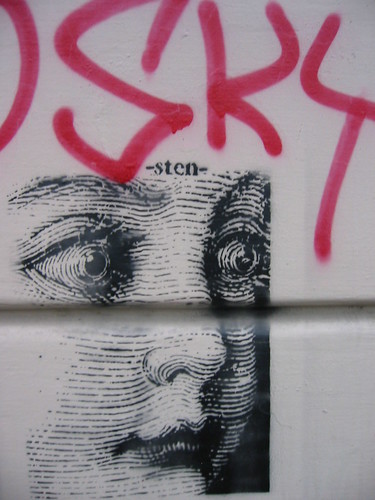
But who . . . logs the patience with which most of the people here live, since it is part of their very nature to view everything regarding their own condition as not worth communicating, to be self-effacing and hold their tongues about it all. Such an attitude . . . revealed a certain background. If you . . . had had a bourgeois upbringing, you would come with the assurance that everything happening to you concerns you and challenges you to express your opinion. Wherever you wound up, you could as a matter of course, claim any situation for yourself. Instead you still bear the weight of experiencing your inferiority, you believe that no none wants to listen to you, you are uncertain as to how your studies can be utilized, expressed. This is something . . . that I have repeatedly found in conversations with young workers, they shy away from transmitting their knowledge because they are filled with the scorn shown by others, because they already sat of the sidelines in classrooms, allegedly with no calling for science, scholarship, art, for running a business, predestined to enter the machinery as soon as possible, at the very bottom.Trying, as always, to rub up a little conflagration, or, contrarily, make mischief glow with a possible nuance, something scumbled out—or stenciled in—by the merest juxtaposition. My ongoing argument for metaphor, not a veering off into something “other,” rather, a concatenating of immiscibles, new revealing, new solution, new noise. Useful slurry, to patch a gap where none existed before. Weiss:
Thus the extended vanishing lines of the contours of Feininger’s houses opened up an entire city, and, spraying like comets, the shapes on the tower of the blue horses introduced a vitality that could never be reached by conventional methods of representation. Such surprising depictions, based not on a closed aspect but on a multivalence, supplied more details than static arrangement could about the mechanisms we lived among. Characteristic of that ambiguity was its ability to get the imagination to seek links, thereby expanding the realm of receptivity.What’s incomprehensible is how Weiss’s novel is only now, thirty years after its publication in German, being translated and made available in English (by Duke University Press, the first of three volumes is out).


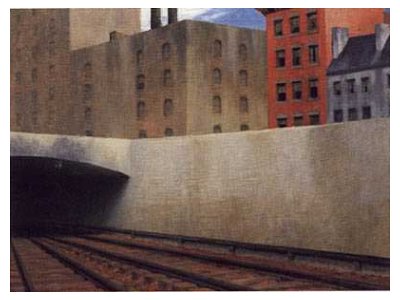
JOHN MORSE: Mr. Hopper, I'd like to ask you about one particular picture that made a great impression on me when I first saw it at the Whitney exhibition . . . That's Approaching a City . . .
EDWARD HOPPER: Well, I've always been interested in approaching a big city in a train, and I can't exactly describe the sensations, but they're entirely human and perhaps have nothing to do with aesthetics. There is a certain fear and anxiety and a great visual interest in the things that one sees coming into a great city. I think that's about all I can say about it.
JOHN MORSE: Well, in painting this picture were you aware of these wonderful solid geometric forms that took my eye at once?
EDWARD HOPPER: Well, I suppose I was. I tried for those things more or less unintentionally.
JOHN MORSE: Would you go so far as to say it's almost a subconscious result, effect?
EDWARD HOPPER: Yes, I think so.
JOHN MORSE: But what was in your mind when you were painting it, I gather then, was this feeling of approaching a city?
EDWARD HOPPER: Yes.
JOHN MORSE: Thank you.

I think that the ideal way to go about making a performance or a work of art—and I don’t think that they should be different, really—is to assume that when you begin, you don’t quite know what it is about. You only come to know as you proceed. As you get two thirds of the way through the session, you are two thirds of the way along toward a conception.Hence the enormity of my distrust of those who have mapped out a program, a style, a (chance) method, the “next poem.” Bah!

A person belonged to the working class if he acted on its behalf no matter where he came from.On Gaudí’s Sagrada Familia, found in Barcelona, en route to joining the International Brigades (one formula for an all-embraceable art-practice):
. . . compound of kitsch and architectural vision . . . it seemed to us as if the disinterested way of treating all artistic directions, the lack of a specific, so-called sure taste, had been the prerequisites for creating this monstrous and completely free-standing formation.And:
. . . the work may not have been carried through because the ecclesiastic and religious motives for the construction had lost all meaning, the devotional place had been erected around a drained idea, and that was why such a cathedral could only remain incomplete, could survive only as a fragment, find its value in a hyperreal omni-art opus . . . the edifice could retain its authenticity solely as a ruin . . .(Me, aghast to learn that “in the middle of the Gran Via . . . the architect was killed, under an electric trolley, he was wrapped around the wheels, shredded, rolled up, in June nineteen twenty-six, the swift, jingling, and roaring thing ran over Gaudí’s private world.” Recall a morning—early ’seventies—of climbing high up in the open latticework towers, espying encrustations of organic gewgaws and boxy stone saints . . .)


On a crude lime-washed wall in a stable furnished with the barest necessities, someone had painted a picture that gave no heed whatsoever to the provisional arrangement, it had been put into the haze of onion soup and black tobacco, staunchly it rose, with utter equanimity about the fact that cracks were already running though the plaster, that the thin layer of pigment would soon be scraped up and scratched up, would burst because of the humidity and the settling of the clumsily laid fieldstones, it defied its ephemeralness, it devoted the utmost of its abilities like the fighter in the field, it presented itself as if painted for a long duration, for the cosmic length of time we would be spending here in Spain, in an enormous concentration of energy, the picture stuck fast to the wall until with our victory or our defeat only flecks would survive, and it clung most obstinately where the strokes were most densely combined, in the faces, the hands.—
Catalogue of Fashionable Ideas
Lyric poetry is finished.
There is no demarcation between self and Other.
Fiction cannot teach a poet anything.
Freedom means rampant ungoverned choice—thirty brands of detergent, two political parties.
Realism (naturalism) is done for.
Fragmentation, piecework (“showing the stitches”) expresses the contemporary condition.
Adorno, better than Montaigne.
Kathy Acker, better than Jane Austen.
Charles Olson, the first post-modernist.
I is subject-position.
Nobody’s seen Thomas Pynchon since he ducked out on the Life magazine photographers at the marriage of Richard Fariña and Mimi Baez.
Popular enthusiasms:
Jeff Koons
lists
Brenda Hillman
“comix”
David Foster Wallace
public space shenanigans
Emperor penguins
poor digital photographs
Indie / DIY
Wikipedia
Jack Spicer
many-artedness (dilettantism)

Ownership molded the attitude that was taken toward things, while for us, to whom the living room never belonged and for whom the place of residence was a matter of chance, the only elements that carried weight were absence, deficiency, lack of property. There was no wasting any breath about it, at that moment I could not have mentioned anything but the iron can opener that I saw lying on the buffet, shaped like a herring, the lower jaw protruding as a bayonet-like cutter, it had already existed in Bremen, I had played with it, no doubt, and my mother had taken it out of my mouth. Otherwise we had no time to think about the frugality, our life story consisted more of figuring out how to get through the next few days and weeks, how to pay the rent, than of registering objects among which we were barely tolerated.And:
And how should writing even be possible for us, I asked myself . . . If we could grasp anything of the political reality we lived in, how might this flimsy, dwindling material, which could be obtained only in dribs and drabs, ever be converted into a written page with a claim to continuity. Tranquil and persistent research and reflection were beyond our reach. The events thronging in on us forced us to gain insights that became fierce reactions. They could lead to actions, but they could not be rounded off, could not yield an overview. They always had to remain fragmentary, had to be torn apart, wiped away by newly surfacing demands.Not to imply that one’s own situation is pointed at here, or even any of one’s reader’s lives. After all, one is comfortably surrounded by things, fucking things. Imagine, though, a whole literature writ by those without.

flary, adjective, rare.
Gaudy, showy.
1866 “They were not so well dressed as their Edinburgh sisters; something flary, glary, colours too flagrant and ill-assorted.”
1873 “Flary, staring, and conceited, stolid-looking girls.”

Poetry XX century like all arts and sciences is devolving into examination-experiment on the very material of which it’s made. They say “an examination of language itself” to express this turnabout from photographic objectivity to subjective-abstract composition of words à la Burroughs.—
As post-Einsteinean science is supposed to come to the frontier of objective research whereat the research instruments themselves are questioned, the human measuring brain is analysed as far as it can analyse itself, to see how the structure of the brain-mind determines the interpretation of the “outside” universe—now found to be contained in the mind perhaps & having no objective shape outside of the measuring mind.
So painting changes thru Cezanne to tricks of space, thru cubism to analysis, finally thru Action to the paint itself as the subject matter.
So music moves from old habitual scales & harmonies to abstract mathematic potentialities unrestricted by human pre-supposition.
Now poetry instead of relying for effect on dreaminess of image or sharpness of visual phanopoeia—instead of conjuring a vision or telling a truth, stops. Because all visions & all truths are no longer considerable as objective & eternal facts, but as plastic projections of the maker & his language. So nobody can seriously go on passionately concerned with effects however seeming-real they be, when he knows inside all his visions & truths are empty, finally. So the next step is examination of the cause of these effects, the vehicle of the visions, the conceiver of the truth, which is: words. Language, the prime material itself.
So the next step is, how do you write poetry about poetry (not as objective abstract subject matter à la Robert Duncan or Pound)—but making use of a radical method eliminating subject matter altogether. By means of what kind of arrangements of words:
Radical means:
Composition in Void: Gertrude Stein
Association: Kerouac & Surrealism
Break up of syntax: Gertrude Stein
Arrangement of intuitive key words: John Ashbery’s Europe.
Random juxtaposition: W. S. Burroughs
Boiling down Elements of Image to Abstract Nub: Corso
Arrangement of Sounds: Artaud, Lettrism, Tantric Mantras
Record of Mind-flow: Kerouac
I seem to be delaying a step forward in this field (elimination of subject matter) and hanging on to habitual humanistic series of autobiographical photographs . . .
Art has always convinced us only by filling the painted plane or the written pages with a life of its own. Whenever precautions are taken to steer art, they merely confirm that it has a mind of its own. The more tightly art is bound, the more people fear the danger of its explosive energy. From this insight it is not far to the suspicion that not everything that claims to be exemplary conforms to the facts.And:
The slow calm execution of a work within a sequence solidified by tradition was replaced by a demand for originality, newness was attributed not to mature craftsmanship but to genius, and this pressure to be singular, to dedicate oneself to individuality led to isolation, to brooding, to the dominance of personal suffering, to surfeit, so that eventually art per se was called into question.


Dadaism . . . had spit into the elegant parlors, it had toppled the plaster busts from their pedestals and shredded the garland of petty bourgeois self-aggrandizement, that was fine with us, we endorsed the ridiculing of dignity, the deriding of holiness, but we had no time for the call for a total annihilation of art, people who were sated with culture could afford such slogans, but we wanted to take over the cultural institutions left unscathed and see which of their contents could be made serviceable for our craving to learn . . . we drew the line between attacks against worn-out perishing things and mere thumb-nosing that ultimately left the market in peace. We thrashed out the conflict between those who preferred to depict the present in its intricacy, fragmentation, and chaos, making it blaze and burn, like Nolde, Kokoschka, or Beckmann, and those who preferred to render the disintegration objectively and accurately, like Dix and Grosz . . .


It makes no difference what the genre is, whether praise or satire or description, or whether the style is subtle or obscure, for any one will pay concentrated attention to a work in which he in his own name is a principal character. But such personal writing about the audience itself can occur only in a small community of acquaintances, where everybody knows everybody and understands what is at stake; in our estranged society, it is objected, just such intimate community is lacking. Of course it is lacking! The point is that the advance-guard action helps creates such community, starting with the artist’s primary friends.And Olson, in an August 9, 1951, letter to Robert Creeley:
“. . . all this damn funny recent verse—all of it, if you will notice, directed to actual persons, composted, actually, by and for OCCASION.”(Love that “composted”—likely a “mere” typo; worthy, though, of Jed Rasula’s attention.)
“(1), that you and I restore society in the act of communicating to each other . . . & (2), that what i mark about this correspondence is something i don’t for a moment think is peculiar to thee et me—that the function of critique is more than the mere one of clarities (as, say, Flaubert, &, Mme Sand) it is even showing itself in the very form of our address to each other, and what work goes along with it”And:
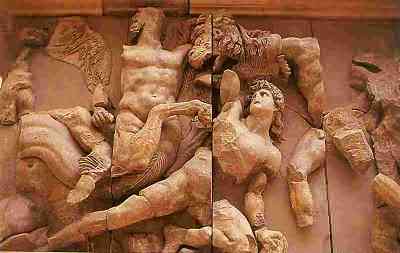
“I put it as of us, but, we do say to the Great Society, go fuck yrself (which Ez was not quite able to do!), and quietly create a society of our wives and friends—and without even trying to make it what DHL [D. H. Lawrence] wanted Trigaron or some such ‘community’ to be in Florida!”One question: what “hath” Blogland wrought of “quiet” community? Does it turn out that public clamor (and posing) is no community at all? (Mostly I am caught in the colossal sweep of Weiss’s The Aesthetics of Resistance, thinking of the now-Turkish hills of Pergamum, the heroic Pergamon Altar removed to Berlin.)


Provincialism of time is as damned as provincialism of place; our evils come in great part from the fact that we are governed by men who take count of too few of the facts, as the poverty of modern art movements lies in the paucity of the mental reference of the artists.—
In art and in politics this paucity of reference results in febrile stirs and excursions; legislator and artist alike are over-excited by a phenomenon because they have no means of judging the frequency or infrequency of its occurrence. The rare faculty and the significant datum are lost in the sea of clichés. (New Age, August 28, 1919)
Eurystheus . . . tearfully recited poems, accompanying them, off-key, on the lyre, but when Linus, the tutor, tried to inveigle Heracles into believing that the only existing freedom was the freedom of art, his pupil yanked the man’s hat down so hard over his eyes that he broke his nose, and when the schoolmaster then claimed that art was at all times to be enjoyed independently of the contemporary chaos, Heracles thrust him headfirst into the cesspool, drowning him to prove that unarmed aestheticism cannot withstand the simplest violence. He had already once beaten the daughter of Mnemosyne, she too a relative, for daring to presume that she alone could settle all issues of dance, music, song, and poetry, Heracles preferred the ditties sung in the streets and the shrill reed flutes, the caterwauling bagpipes, the whacking of drums in the taverns. Wandering around the urban outskirts despised by the muses, he got to know the poverty that was at home in shacks and basements, and it was always the maids and farmhands, the cringing domestics, the day laborers, the small shopkeepers, who starved and were sucked dry by the inflicted tributes, while the castles had overabundant meat, fruit, and vegetables. Just as the wine vats there, and the treasure chests, were always filled.—

Reality is a place you can access only with the proper clearances. Everything genuine disappears. What’s left, the cardboard maze we’re free to scurry about in, is pure Dittoland.—
Rough parallel wd. be to imagine Edison setting out NOT to invent the electric-light bulb but just to invent, at large, anything that happened in the course of his twiddling with this that and the other.—
The opposite, going not to seed but to confusion, is manifest in those who set out to find PROOF of something or other. Even this mania, this one-trackness occasionally ploughs up more truth than mere lack of direction . . . Some kind of line to hang one’s facts on is better than no line at all.

Dittolands, an Etherian idea of small town America mass-produced on huge space platforms and transported to Earth for jiffy erection in remote locales, on abandoned land. There were supposed to be hundreds of them all over the country inhabited by a skillfully integrated population of human collaborators and Etherian copies of real Earthlings. In Dittoland out for a jog you just might run into yourself.—

The situation is that of him who is helpless, cannot act, in the end cannot paint, since he is obliged to paint. The act is of him who, helpless, unable to act, acts, in the event paints, since he is obliged to paint.
D.—Why is he obliged to paint?
B.—I don’t know.
D.—Why is he helpless to paint?
B.—Because there is nothing to paint and nothing to paint with.
—Samuel Beckett, “about 1949, in a series of prose Dialogues with Georges Duthuit.”

While, with poring eyeApplied bucko years later to anthropological theory, to physics, partout. Noted two photographed graffiti scrubbed clean today. “Hurry up please it’s time.” A week or so before White departed the earth: three successive days of recording the number of cucumbers he cut.
I gazed, myself creating what I saw.
His story, the one you tell deep in the ladderless hole of tapped-out nights on secondary roads when there’d be enough money for a couple six-packs and your faith in a country as big as dreams had dwindled to the hope the raw sun wouldn’t find you in a ditch, hot wind from highballing semis blowing cinder dust and ragged litter over your oddly humped back or the moon catch you in a graveyard telling tales to ghosts and even through impossibly thick boughs its soft penetrating beams pick out the thin streak arching over your own cheek and paint it silver.Enough to make you begin a series of photographs of trash, or spout classics nobody knows anymore:
When Lil’s husband got demobbed, I said—Which is how American poetry is going these wind-up days to a greater conflict (and greater meds for us civvies in the lurch, inutile and awkward with out fucking little word-toys glimpsed vermilion by the rocket’s burnout . . .)
I didn't mince my words

May 16. Wheat looks somewhat yellow. Men sow barley: but the ground is cold, & cloddy.The syntactical consistency reduces all event to its matter-of-factness, sheer unalloyed facticity. The clever tortoise Timothy (whose carapace now resides in the British Museum) is on equal footing with (the shipping out of) Sim Etty, the Selborne vicar’s son, whose activity is of no more note than the “blow” of the variegated columbine. The Gordon Riots of the penult entry: same old same old in spite of the declared “unpresidented”—more “No Popery” doings. There’s a fine ecological humility before the language: it serves to humble all, anti-hierarchical, sufficient, blunt. It lacks all smarm.
May 18. Field-crickets in their pupa-state lie-out before their holes. Magpies tear the missel-thrushes nest to pieces, & swallow the eggs.
May 19. Helleborus viridis sheds it’s seeds in my garden, & produces many young plants.
May 27. Large blue flag iris blows. Flesh-flies abound. Timothy the tortoise possesses a much greater share of discernment than I was aware of: & . . . “Is much too wise to go into a well;” for when he arrives at the haha, he distinguishes the fall of the ground, & retires with caution, or marches carefully along the edge: he delights in crawling up the flower-bank, & walking along it’s verge.
May 29. The tortoise shunned the heat, it was so intense.
May 30. Columbines, a fine variegated sort, blow.
May 31. Master Etty went on board the Vansittart India-man at Spithead. Thunderstorm in the night with a fine shower.
June 1. Distant clouds, sultry, thunder-clouds. Sulphurous smell in the air. Sweet even, small shower. Strawberries blow well. Medlar shows much bloom. Honey-suckles blow. Fern-owl chatter: chur-worm [mole cricket] jars. The tortoise shuns the intense heat by covering itself with dead grass; & does not eat ’til the afternoon. Terrible storms in Oxfordshire, & Wilts.
June 2. Finished papering my great parlor.
June 3. The phalaena called the swift night-hawk [humming-bird hawk-moth] appears.
June 5. Tortoise does not move. Tulips fade. Cinnamon-roses blow.
June 6. Red valerian blows. [Later note.] Terrible riots in London: & unpresidented burnings, & devastations by the mob.
June 8. The limes show their bracteal leaves, & rudiments of blossoms. Sweet Williams begin to blow.


We were drinking gin and tonics on the terrace when the midi skirtNone of relational oomph between title and poem that the Ashbery piece wallops. Is the only identifiable effect / affect here one of smarm? Clover’s lately been quick to defend theory (in critical writing) against (what I’d call) style. What if theory’s upshot, impingement, is fixity: not rigor—rigor mortis? Text clotted with texts? What then?
Came back into style . . .
De Almone
Omnes eunuchos habet Almo, nec arrigit ipse:
et queritur pariat quod sua Polla nihil.
On Elmer, A Confused Person
Though all his associates are eunuchs, and
he himself is the eunuchest of all,
poor Elmer fails to understand
what he likes to call
the undeviatingly sustained unimpregnability
of his wife Pol.


She used to wear dresses down to her ankle——
Now she wear ’em so short you can see her twinkle.

The killing eye, the blessing lip—
That shews the art of Love,
Is but a poor and thirsty sip
Our burning hearts to prove.
(The errant eye, the bluffing lip
That shews the love of Art
Is but a poor and thrifty Fib
Our wrecked careers to start.)
There is an old English Proverb, That Truth must not be utter’d at all Times, nor to all Persons; and that is the reason, I suppose, why Men of late publish their Sentiments in Masquerade. We have already seen the Parables of the Bear-baiting, and the Magpies; now give me leave to present you with that of the Shark and the Herring-Pond, since after Four-footed Beasts, and Birds, Fish comes next in course.(Suggestions for clarifying linkages sought and accepted.)
There was a Time, when the scaly Inhabitants of the Ocean were divided into several Empires, Kingdoms, Commonwealths and Provinces; each watry Nation being subject to their respective Sovereigns, even as ’tis here on the Land.
Among the rest, the Shark reign’d over the Gudgeons; he a voracious, cruel, tyrannical Fish; they silly, tame, weak, despicable Animals, cut out for Slavery and Contempt. This Shark, or King of the Gudgeons, was the worst of all his Race; for he would enter into Leagues with other Royal Fishes, his Neighbours, only to render them the more secure, whilst he amass’d up huge Treasures by Oppression of his Subjects, and rais’d great Armies, with design, to rush suddenly upon his Friends and Allyes to bring them into Contribution and Slavery.
He had one potent Neighbour, who was an Emperor among the Fish, and had many Princes subject to him. The Shark bore a great spight to this Imperial Fish, and often invaded his Territories, and made great Havock and Devastation among his Subjects; for he would come on the suddain, (as ’tis the nature of that sly Fish,) and snap off a whole Limb, or Branch of the Empire, together, at a Mouthfull; and this at such time as they were all in Peace, and never dream’d of any such Usage. And to shew that he absolutely design’d the total Ruin of the Imperial Fish, and all his Dependants, the Shark sent Ambassadors to the Whale, a mighty Fish; and who had the largest Dominions, the strongest Armies, and richest Treasury of any Royal Fish in the Ocean: A proud Fish also, proud as Lucifer; for disdaining all Earthly Emblems, he wore the Moon for his Crest, and styl’d himself the Shadow of God. To this terrible Whale, I say, the Shark sent Ambassadors, and made private Leagues with him, against the Imperial Fish, persuading him to send Armies to invade the Imperial Territories. Thus whilst the Imperial Fish was buried on one side, in defending himself and his Empire against the Incursions of the Whale, the Shark takes the Opportunity; and breaking all his Treaties of Peace, leaps suddainly into the Bowels of the Empire, plundering, murthering and desolating all, wheresoever he came.
Yet the Shark, not content thus to ruin the Imperial Fish, sets upon another King among the Scaly Nations, that was a near Relation, Friend and Allye of the Imperial Fish: He sends Armies, and invades the Territories of this King also, who was called the Sea-Bull; lays waste his Dominions, leads his Subjects into Captivity, and does him all the Mischief that his Malice, Ambition, Covetousness and Pride could prompt him to.
Thus begun the Poetry Wars . . .

Pseudo-Alchymists that labor against quicksilver, sea salt and sulfur dream of hermetic gold through transformation, yet they fail to grasp the natural course of development since what the employ are literal reading of receipts. Accordingly they bring baskets of gilded pebbles to sell, or drops of vinegar in cloudy alembics—futile panaceas meant for a charnel house. This is false magistery.
Thousands proclaim themselves Adept that have dealt little with spagyric matter. By such conceit they disenfranchise the conscientious aspirant. Puffers abound—monk-bellied wizards proposing deleterious recipes in lieu of knowledge. Granted a crock of paste I doubt any could fix a fractured pot. Their persuasions are wretched, false and degenerate, their devices precarious.
I have watched charlatans with the help of greasy advocates cloaked in malfeasance skipping and bleating merry as goats. But as a metallic stone attracts and repels iron particles according to its animus, so does every man attract or repel effluvia for evil or good. And what he is, that will he be at his death since the spirit does not deviate from itself. Consequently each man endows the atmosphere with a vestige and register of his life. And I say that as the angry light of dawn will diminish a candle, so does alchymic magistery eclipse and shame the artifice of squint-eyed gut-bucket butchers serving slabs of deceit. I would not award them Christian burial. I would hang them upright like Diogenes to scare off crows. Cucurbit, alembic, furnace, retort—only thus shall we hear the human predicament annunciated, since within our Philosophic Egg begins a fabulous process of fermentation, distillation and extraction.


My only activity is to deny my isolation: I grope in disorder for former existences where, instead of being a prisoner, I flew in all directions like a wild missile. And that contradiction, I’m sure, accounts for the wildly fluctuating structure of my work: maniacal alteration between plunging and surfacing. An episode is born every time I sit down to write. Every writing session is a singular event in itself, and only forms a novel to the extent that I bind myself to my shattered past. An event of its own, my book writes me.

May 2006 June 2006 July 2006 August 2006 September 2006 October 2006 November 2006 December 2006 January 2007 February 2007 March 2007 April 2007 May 2007 June 2007 July 2007 August 2007 September 2007 October 2007 November 2007 December 2007 January 2008 February 2008 March 2008 April 2008 May 2008 June 2008 July 2008 August 2008 September 2008 October 2008 November 2008 December 2008 January 2009 February 2009 March 2009 April 2009 May 2009 June 2009 July 2009