
Writing
No apparent notice in sleepy, hardly voracious Blogland of Lytle Shaw’s Frank O’Hara: The Poetics of Coterie (University of Iowa Press, 2006). First chapter here in Jacket. What glints up out of my first perusal, is Charles Olson tooting out a response to Paul Goodman’s 1950 essay, “Advance-Guard Writing, 1900-1950.” Goodman:
It makes no difference what the genre is, whether praise or satire or description, or whether the style is subtle or obscure, for any one will pay concentrated attention to a work in which he in his own name is a principal character. But such personal writing about the audience itself can occur only in a small community of acquaintances, where everybody knows everybody and understands what is at stake; in our estranged society, it is objected, just such intimate community is lacking. Of course it is lacking! The point is that the advance-guard action helps creates such community, starting with the artist’s primary friends.And Olson, in an August 9, 1951, letter to Robert Creeley:
“. . . all this damn funny recent verse—all of it, if you will notice, directed to actual persons, composted, actually, by and for OCCASION.”(Love that “composted”—likely a “mere” typo; worthy, though, of Jed Rasula’s attention.)
Later, as Shaw notes, Olson “quickly theorized his correspondence with Creeley . . . as producing two necessary changes that should be understood in terms of community”:
“(1), that you and I restore society in the act of communicating to each other . . . & (2), that what i mark about this correspondence is something i don’t for a moment think is peculiar to thee et me—that the function of critique is more than the mere one of clarities (as, say, Flaubert, &, Mme Sand) it is even showing itself in the very form of our address to each other, and what work goes along with it”And:
“I put it as of us, but, we do say to the Great Society, go fuck yrself (which Ez was not quite able to do!), and quietly create a society of our wives and friends—and without even trying to make it what DHL [D. H. Lawrence] wanted Trigaron or some such ‘community’ to be in Florida!”One question: what “hath” Blogland wrought of “quiet” community? Does it turn out that public clamor (and posing) is no community at all? (Mostly I am caught in the colossal sweep of Weiss’s The Aesthetics of Resistance, thinking of the now-Turkish hills of Pergamum, the heroic Pergamon Altar removed to Berlin.)

Pergamon Altar
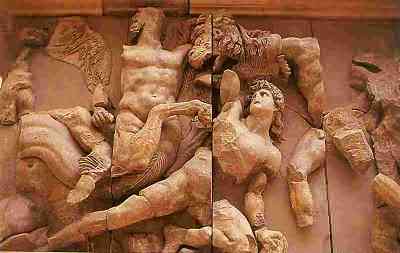
Pergamon Altar, Detail
—No good poetry is ever written in a manner twenty years old, for to write in such a manner shows conclusively that the writer thinks from books, convention and cliché, not from real life.
—Ezra Pound, 1912. “Prologomena,” Poetry Review (London)
