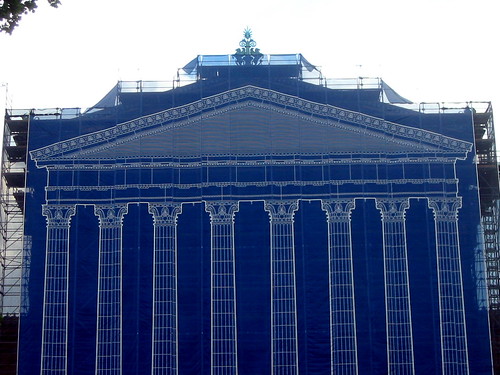
Friday, July 18, 2008

Church of the Poison’d Mind


“Where They May”

“The reverend takes this opportunity to step over to the sideboard and pour himself, as he says, just a line of the old author.” (That’s out of Jaimy Gordon’s novelette, Circumspections from an Equestrian Statue (Burning Deck, 1979), something I found myself reading around midnight, in a fit of fictive immobility, certain that whatever truth there is to be “got at” by any other means is hardly worth the scavenging. (The novelette’s all “about” General Ambrose E. Burnside, he of the “Burnside breech-loading rifle,” who “invent’d” les sideburns, rage of mid-nineteenth century Paris—and the Doctor P. Mariam Wishey, “architect of the vagina, inventor of the Wishey Speculum, Position, and Procedure, and of the Wishey Silver Sutures for that tenderest theater of the art”—it is about there (sad hap and havoc) that I tumbled back under Lethe’s soporific keister, yea, the horse’s ass of sleep, rebuttal of all truth.) Though not before noting reference to one “Captain Moran, recognizable by the famous left ear which a military macaw had notched like a gear wheel,” and Burnside’s “theory that the nose is the seat of the soul. Not the pointed end of it, but the little cavity or sea behind it and this we know because the point is erected over it by Providence as a sort of temple, an Athenaeum.” Legion the gaspy delights. Whatever “hap’d” to Jaimy Gordon (isn’t she in Kalamazoo?) I dig out my copy of Shamp of the City Solo (Treacle, 1974), publish’d by Bruce R. McPherson, pre-McPherson & Company. Whatever “hap’d” to the unobstruct’d saliences of the picaresque? Shamp is a scramble, with pen and inks (by James Aitchison), newspaper clippings, recipes, syllabi, ditties, footnotes, lectures, songs, braggadocio. It begins with “Thanks All Around”:
        From Shipoff I learned to move in the world: how to solo, to fit where your foot falls, and always to keep an eye on the exit; where you cannot rule, to serve; and to talk unceasingly, for no word is wasted, nor can a word be empty, but even popped off in vain, lights up the point that popped in the lector’s brain . . .
        He taught me to covet the life of a lector, to crave to orate the most timely topos from a lectern in Big Yolk, the city-solo . . .
It all rather unsettles me, how the rashy virulence of prose experimentalism in that “period”—the prevalent story anthology in the university one titled Anti-Story—and the hubbub of ev’ry-wch-way poetry along behind, disparu, tout disparu, just like Jimi Hendrix. Whence passeth it all? (There’s likely a story “available” concerning the arrival of Raymond Carver’s strip’d-down Hemingway muggery, the incipient crop of Ann Beattie lady realists “funk’d up” with brand name doodadery, making it all so “explicable”: I ain’t the one to tell it.)

And it’s unlikely that such a traversal is anywhere near a direct route to Charles Bernstein’s somewhat flatulent (inflated) review of Alan Filreis’s Counter-Revolution of the Word: The Conservative Attack on Modern Poetry, 1945-1960 (University of North Carolina Press, 2008) in the recent Boston Review. Which is where “one” is going. (It’s one thing to resort to a little “brainpan cooling” nap, another to rouse oneself to a stove caught fire in the wrong room, unable to distinguish (or extinguish) one’s “temporary” enthusiasms.) Why does Bernstein so persistently attempt to stretch the parameters of the study up to today? Bernstein says: “the toxic mix of what Filreis calls “anticommunist antimodernism” is not only pervasive in the 1950s, but also provides an ideological foundation for the official verse culture of the 1970s onward.” [It is odd to note how, in a review that points repeatedly at the vocabulary of the attacks against “non-conventional poetry”—“alien,” “barbarous,” “poison,” etc., Bernstein quickly amasses a set of tit-for-tat rejoinders: “toxic,” “noxious,” etc.] Bernstein says: “The connection of radical formal innovation to genocide is likely to strike contemporary sensibility as bizarre. These ideas, however, belonged to the immediate postwar mainstream, and they underwrite the allegorical unconscious of the anti-modernist factions of official verse culture in our time.” [It makes no difference whatsoever, of course, that “underwrite allegorical unconscious” is thorough gobbledygook: the point is we are still under attack. Which smacks of the doctrinaire Bush-Rove Republican method of “rallying the boys,” no? Invent a danger in order to buck up a faltering constituency.] Bernstein says, again:
The demonization of the aesthetic left in poetry is still with us. It persists, often in defensive, sometimes farcical, form in the teaching and writing of those who, ironically, may sense they are on the wrong side of history. As with anticommunist antimodernism, dogmatic protest against the dogmatism of others is the standard operating procedure. The intellectual heir of anticommunist antimodernism is a post- or neo- liberalism that underwrites its defense of dominant aesthetic values as common sense. Critiques are dismissed as unjustifiable agonism (ideology of the avant-garde), part of a struggle that is now said to be outmoded. The post-partisan creed is that the avant-garde has won its battles and now it is time to return to kinder, gentler forms—poetry with a human face. It is the end of ideology all over again. The only way not to be divisive is to accept the dominant poetic values as inevitable and natural, as craft rather than ideology, sincerity rather than artifice.
(There’s something of a raw pathos to be extend’d, one supposes, to the claim that opponents “may sense they are on the wrong side of history.” Who—except Marjorie Perloff saying “I like to pick winners”—is so completely temper’d by posterity as to think anyone in the daily agon and rut and removal considers history’s “sides”? I’m remind’d of O’Hara’s brilliant riposte, “you just let all the different bodies fall where they may, and they always do may.” Unless, of course, one is best known for Controlling Interests. Once one arrives at the final sentence opposing “craft” to “ideology,” “sincerity” to “artifice,” one sees Bernstein’s on automatic pilot, Filreis’s book long abandon’d, rehashing the arguments of thirty years ago. Funny stuff out the mouth of the “stature’d”.) And, still unable to relent, Bernstein says: “The ideology of the ’50s anticommunist antimodernists is now embedded in the mainstream; it has come to shape common assumptions of popular taste about poetry.”

Tellingly enough, the one point of common ground Bernstein finds with the “aesthetic and political right” is that a politics of form indeed exists (“One thing the anticommunist antimodernists had right was that the poetic form of radical modernism was political; Filreis calls this the “cold war politics of poetic form.”) Here, one’s got Filreis borrowing the Bernstein construction “politics of poetic form”—see the Bernstein-edited 1990 Roof book of that title—applying it to the “anticommunist antimodernists” stance, and Bernstein (handily) returning to ratify it. Is poetical form politically efficacious? Frankly, disjunctings poetickal seem an astoundingly crude insufficiency of means for world-changing, and defense of such (particularly in times of emergency—see Bernstein’s response to the Poets Against the War project at the beginning of Bush’s illegal and immoral preemptive war: “At these trying times we keep being hectored toward moral discourse, toward turning our work into digestible messages. This too is a casualty of the war machine . . .” is Bernstein’s paltry aesthetical quibble when the shining clarity of moral anger’s call’d for.) Bah. Filreis’s book’s a better document than to be used as a mere platform for Bernstein’s own peccant worries about Charles Bernstein’s place in history.

Charles Bernstein

Thursday, July 17, 2008

Frank O’Hara Post Frank O’Hara


FB OX

Another entry by Kent Johnson in the ongoing saga of The Frank O’Hara Story (starring, amongst others, Jeni Olin as the young Frank—“So if you see me fighting a tiger, / Go & help the tiger!”):
Quick Notes on a “Hidden” Frank O’Hara Document
“You and I make one weird team, / old buddy!”
(The Sun to Mayakovsky, towards the end of “An Extraordinary Adventure Which Befell Vladimir Mayakovsky,” the poem which inspired “A True Account of Talking to the Sun at Fire Island.”)
“Go back to sleep now, / Frank, and I may leave a tiny poem / in that brain of yours as my farewell”
(The Sun to O’Hara, towards the end of “A True Account of Talking to the Sun at Fire Island.”)
So odd to write this on a day (7/15) that The New York Times publishes on its front page an article about the mysteries of Fernando Pessoa’s authorships, the gaps in their record, the deep agonistics and saudade over what those gaps may mean, how they might be explained, where the gaps should “remain,” if they cannot be fully explained . . .

And to write, too, on the same day as David Shapiro’s stunningly brilliant, enthralling, and moving response here, inasmuch as Shapiro, a poetic hero of mine (the first “avant” poet I ever read, and by pure accident, at 16) and with whom I’ve long corresponded, sent me, approximately two years ago, a huge package of Pessoa memorabilia he had just brought back from a reading and lecture tour he’d done in Portugal!

Well, sentiment aside, I had mentioned (in Postscript to my “Reply to Tony Towle” a few days ago) that I was in process of looking into some intriguing archival materials intimately related to the matter of Frank O’Hara’s “A True Account of Talking to the Sun at Fire Island.”

Copies of these materials came to me yesterday in the regular mail, and I’ll remark a bit now on their contents, with a view to elaborating some comments and speculations in a near-future follow-up at Isola di Rifiuti—comments and speculations that I know will not be kindly received, to say the least, by some.

But let me say, for now, however counter-intuitive the claim may seem, that even this new material I will now present does not completely close the mystery of “A True Account of Talking to the Sun at Fire Island.”

No, it does not . . .

And let me say, too, against the grain as it may be to say it, and with bows to all those who entered his company, that I strongly suspect Frank O’Hara would have been perfectly delighted that true questions remain.

Well, then . . .

Following an extended and intriguing email exchange between us this past week, James Jaffe (James S. Jaffe Rare Books is the premier dealer in materials related to the “New York School” of poets—you’ve got to see his catalogue!) very, very generously sent me a Xerox copy of a four-page item he purchased last year and which he has recently placed in public sale for $6,500.

The item [#20586 in online catalogue] comprises a full-page, original transcript of signed letter dated July 19, 1958, by Frank O’Hara to Hal Fondren; two typewritten poems in carbon copy are separately folded with the letter: a French-titled and later-revised version of the soon-to-be-famous “Ode: Salute to the French Negro Poets” (dated “July 9, 1958 Fire Island”), and “A True Account of Talking to the Sun at Fire Island” (dated “July 10, 1958 [,] Fire Island”)—a poem only first known, of course, in 1966, following its unveiling by Kenneth Koch, at the memorial event for O’Hara roughly six weeks after the poet’s death. “A True Account” appears in the typescript exactly as it was later published. (I do not recall seeing the early version of “Ode: Salute” in any O’Hara collections or critical studies, but my memory could be faulty.)

Upon purchase, Jaffe had sent Xeroxed copies of this item to O’Hara’s sister, Maureen Granville-Smith.

Responding to one of a series of queries from me, Jaffe indicated he did not purchase the grouped item from Fondren’s estate. Jaffe also indicated to me that he does not have complete record or knowledge of what the item’s history of ownership or location, over the years, has been.

Now, to offer a first-reply to David Shapiro (and I will aim to comment on other remarks from his post of 7/15 when I write again): No, neither poem is signed by hand.

I have been asked by James Jaffe to not quote verbatim here from the letter, which as I’d mentioned has only recently come on the market; I can say, though, that it is a delightfully engaging piece of correspondence (as Shapiro reports from his weirdly coincidental 7/14 phone conversation with Maureen Granville-Smith, who read him the contents!), wherein O’Hara begins by thanking Fondren for his warm hospitality at Fire Island the previous week, and reports that on the way back he and LeSueur had swung by the 5 Spot for a few hours to eat and get drunk.

A few more highlights, in rough summary:

In the second paragraph, O’Hara tells Fondren of a mélange of incidents and gossip in the days since the visit to Fire Island, breezily naming in process no less than fifteen people of their mutual acquaintance (including Jackson Pollock, George Plimpton, Lee Krasner, and Patsy Southgate).

In the second paragraph, as well, O’Hara apologizes for having forgotten, in the rush of departure, to leave for Fondren “the two poems” he had written over the weekend of his visit. The clear indication is that the typescripts were produced during the visit. He writes that he encloses them. The reference is to “two poems”; no mention of the poems’ titles or their contents is present in the body of the letter.

O’Hara then makes a comment on what Fondren may do with the poems, and it is a comment sure to become famous in O’Hara lore.

Kenneth Koch is one of the people O’Hara mentions to Fondren in the third paragraph. And given that the letter supposedly encloses the stunning poem Koch would first dramatically reveal to the world, reading it at O’Hara’s memorial almost exactly eight years later (a poem widely felt as a foretelling of the poet’s death), the reference to Koch is rather jaw-dropping: O’Hara casually remarks on the “very successful” nature of “Kenneth’s reading” . . .

Then, in the fourth paragraph, O’Hara proposes, and with charming arguments for the notion, that he and Fondren should start an art gallery together.

In the final paragraph, O’Hara reports that he and LeSueur are leaving to go sailing with Bob Cornell for four days; he concludes by remarking he has to get his typewriter (there are numerous machine-caused misfires in the letter) repaired.

The letter ends with a hilarious PS, concerning the costuming in the newly released blockbuster, The Ten Commandments.

Now, a few technical-bibliographic remarks:

The letter, ink-signed “Frank,” is typed on Eagle A Trojan Bond paper; all three leaves of the two poems (two pages for “A True Account”) are on Eagle A Acceptance Bond.

With an eye to equivalencies in typographic irregularities, the carbon copies of the two poems appear, clearly, to come from the same typewriter (the poems are quite obviously typed on a different typewriter—no doubt O’Hara’s portable Royal—than the one used for the letter, a fact that is no contradiction at all.)

There are no handwritten signatures, notes, or corrections on either of the poem copies. In fact, each is in perfectly “clean” copy, with no typed erasures or corrections.

The folds of the letter and poems seem to align, as Jaffe had stated to me in our correspondence. There does, however, seem to be a slight but measurable difference in the folds between the two poems, at least on the Xerox copies in my possession—though my copies are obviously not fully reliable in such regard. In any case, this is a secondary point, as folds may “match” or not, independently of the original sequence of folding, the authenticity or not of materials, etc.

I had written to ask Jaffe if the watermarks on the carbon copies could be detected and the production-run of the paper bond be thus dated. Jaffe kindly attempted to do some research on this, though he was unable to uncover information that would definitively date the paper. The answer to this potentially important question is still outstanding. It is key to note here that a later bond-run production date than 1958 for “A True Account” would obviously mean the carbon copy was inserted with the letter at a date subsequent to its first mailing (replacing another poem originally enclosed), while a contemporaneous dating of the bond to the poem’s typed date would in no way discount the possibility (a likely possibility, in fact) that clean sheets of O’Hara’s typing paper were taken along with his manuscripts and correspondence.

I will, as I indicated, write more on the topic in the near future.

Long live, Poetry comrades, the mystery of the Sun.


Kent Johnson
July 15/16, 2008—

I try to find everything Jeni Olin writes and read it because I suspect that flarf and its “practitioners” (and, truthfully, most of them ought to practice a little harder) may just be something like an afternoon’s nap wet dream canned for posterity Jeni Olin “had” one day between shifts. I try to find everything Jeni Olin writes and read it because she writes things with pizzazz and raucous humor and her line “feels white / against the tensile gloom of life / and I seem intimate with what I merely touch” (as O’Hara puts it, epitaphing a couple of variations, one about a rock “heavy . . . in my heart like an eye in a pot of humus.”) I try to find everything Jeni Olin writes and read it because she writes things like:
                          Neutrons gathered on a cocoa island
Thronged with square-boned teens
With their “succumbing to a disorderly shelf life
Like Tampax in June” tattoos, that same dorsal softness
With the first nasturtium is blooming
The still sky is a clasp for my dress
Though the days are gentle I have one of everything.
Or because she puts together a genius little chapbook call’d The Pill Book (Faux Press, 2008), eighteen riffs with pharmaceuticals for titles (“Lemictal,” “Abilify,” “Xanax”—is there honestly a pill by the name of “Abilify”? what drip of the obvious (in marketing, no doubt) invent’d that?). The eighteen plus one little one that “opens” the book:

ALL THINGS CONSIDERED

People CAN change
If they are just willing
To drive to a pharmacy

I dash’d out and plunk’d down the dimeola for it (though its high-dollar markup—$12.50!—nearly made me falter, particularly “what with” the lousy kerning throughout, that excess spatial “blip” after every h makes for a “constantly correcting” read . . .) Though maybe that’s the result of the sling of jittery particulars and Django Reinhardt “hot swing” pacing that drives these fireballs. Olin’s poems amalgamate one-liners, (“Guess I’ll just sleep my way to the middle,” “‘The weather is here. Wish you were beautiful.’”), a rampantly arch and cunning surreal (“your kneecaps / like the skulls of inbred dogs, / Your penis which looks like a sun-burnt / Baby’s arm & smells of chlorine . . .”; “Nothing to do indeed when heaven is a seizure alert dog on An invisible lead”), genial familiars in the form of brand names (“The Hercules One Arm Bed-to-Bed Transfer,” Popeye’s Chicken, the Morton Salt Girl, “Eileen Myles looks like a Kennedy”), and tiny ambuscades of sentiment (“Angel Gabriel stand on me // When I pass from this earth / In the zip code 10022 & if you should ever leave, // Remember someone, This One, / Remembers you—perfectly.”) It is these latter that provide the girders of “heart” without which the whole edifice buckles and comes down in a heap of irony’s common debris. Here’s one (compleat):
DEPAKOTE

I felt more at home on this pill in the bucolic shire
In the Hamptons amid the piss-colored braids
Of wheat on a metamucil can, milkweed & sneeze drops,
A novelette THE LONELINESS OF A MIDDLE DISTANCE RUNNER
Never checked out in the orangeade foam of dawn
Glistening like a brow in an aspirin ad on the telly
I’ve got a brain like soaked coral.
I’ve got a tongue like a baby’s penis.
I’m Bruce Willis in THE SIXTH SENSE—I’m dead
But I don’t know it.
My pen, my eskimo blood spilled
Cheekily over “good & dear people . . .”
I managed to write this by myself.
When I said “Oh get me away I’m dying,” I meant I wanted
A cigarette and a problem child on a peony-filled evening.
In the dry heat of photocopy fans,
Making Easter cards with the, uh, terminally ill,
You hold the retinal scanner to my heart.
“Now I know how Joan of Arc felt
As flames rose to her roman nose &
Her hearing aid began to melt”
And in the darkened underpass I gave
Blood and now my French is shaky.

Jeni Olin

Wednesday, July 16, 2008

The Heart’s Usable Practices


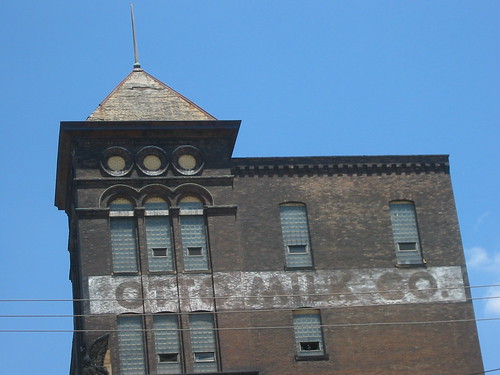
Otto Milk Co., Pittsburgh

Yesterday, unalarm’d, though in a state of abeyance, though not exactly unpreparedness, tenterhook’d by a probability, pans hotting up in the fire, dawdling, I try’d to recall it, something that’d hammer’d at the temple of romantic love in my decimated youth, oh my golden youth! “When I begin to tell anybody but you it begins to be lost” is how I put it. I hate paraphrasing. Something out of an early O’Hara poem-letter to V. R. “Bunny” Lang. “Maybe it says something about an incinerator” is what I put down, uncertainty ruckling through my pores like linen bunch’d or distillery offal, sweet clarity. So I look’d it up. And typed it up, in an excess of forlorn piety for that youth of mine, misplaced somewhere out under the huge rough leaves of the burdocks:
A LETTER TO BUNNY

1
Once before I tried to tell you
about the incinerator. Last summer
while I was living in the hot
city. All day long at the theatre
would flash in my mind this thing
and that thing too, but usually
that heavy cave where there were
no flames bothered me And I
could not tell you, Bunny, then:
there was always my spiral
staircase and the diamond pattern
of the well, the eerie sound of
a quiet house, le Boeuf sur le Toit
and friends who would fight and
would not kill anyone silently.

2
Now, as if this had bothered me ever
since, I find the words are at the
front of my mind. The incinerator
is clearly horrible, soundless, cold.
I went there too often with those things
dear to us both: the tinsels and the
velvets of the stage, the broken sets
and used drapes and tattered scrims,
and they were not consigned to
any glorious or at least bright
immolation. Just a clean dump. Do
you wonder it’s bothered me? you
don’t, we troupers in private know
all about carnival gestures. Before,
I wrote, “it’s grey and monstrous” which
is false, and fumbled after “hints of
mysticism” or “death’s shrewdnesses,”
all notions, all collections of sentiment
that make a poem another burner full of
junk. You enable me, by your least
remark, to unclutter myself, and my
nerves thank you for not always laughing.

3
But I still fear to mention the blue
flowers. They scared me most and I
prolong other talk. There were fields of
them around the place, all blue, all
innocent. The artificial is always innocent.
They looked hand-made, fast-dyed, paper.
They nodded ominously in the sun, right
up to the edge of the concrete ramp, a
million killing abstractions, a romantic
absence of meaning, a distorted prettiness
so thorough that my own eyes rolled up
in fear for their identity and I involuntarily
cried at the thought of tiny mirrors where
the object is lost irretrievably in its own
repetition. Is this how beauty accompanies
fear so it can escape us? Do you think these
flowers could be auctioned tintypes or souls
outside hell? Is blue what they mean by
“shun posterity” and “the price of fame” and
“fear of death”? Have I learned it wrong?

4
When anyone reads this but you it begins
to be lost. My voice is sucked into a thousand
ears and I don’t know whether I’m weakened.
Bunny, when I ran to you in the summer
night and upset us both it was mostly this,
though you thought I was going away. See?
I’m away now, but I’m here. And even if the
rose has been ruined for all of us by religion
we don’t accept these blue flowers. The sun
and the rain glue things together that are not
at all similar, and we are not taken in
by the nearness, the losses, or the cold.
Be always my heroine and flower. Love, Frank.
Written, according to the notes, in Ann Arbor, in October, 1950. O’Hara twenty-four. Funny how what sidles into the greasy brainpan now is not what did a quarter of century back when one first encounter’d the thing. Now it’s: “all collections of sentiment / that make a poem another burner full of / junk.” Poem as incinerator of the sentimental (that’s why—one must recollect, and unstintingly—it throws off heat). I probably recall’d the poem largely because of David Shapiro’s reporting yesterday how Kenneth Koch suggest’d O’Hara’s “all heart.” Of course he isn’t. Though: he is wholly willing to dabble in puddles of sentiment, the private, the ruin’d, the personal—all that that opposes a larger “public” voice. (It is “Personism” handwrit early: “A Letter . . .” to a particular someone is the thing, doable. Beyond that: “it begins / to be lost,” the “voice . . . sucked into a thousand / ears.” Beyond the heart’s nervy and restrict’d stammering: “The artificial is always innocent.” Innocence is heartless, public, associated with “a / million killing abstractions, a romantic / absence of meaning, a distorted prettiness.” So that: the piece shrewdly musters all the arguments against its proceeding (“we don’t accept these blue flowers”) and proceeds anyway. Therein the tension, therein the “heart.” Is that—“heart,” the threat of sentiment’s pure erupting—something available in the writings of the current “era”? (I nearly put “administration,” so heartlessly the train’d dogs keep the product going out.) Product terminally mark’d irony, heart’s deflating stamp. Is there an echo of Williams’s Spring and All “By the road to the contagious hospital” sequence in that letter? Or am I confusing the blue of O’Hara with “the surge of the blue / mottled clouds”?


Silliman’s sullying (again) the barely noticeable rivulet (call it a “rill,” call it a “runnel”) of History Poetickal with ’s “What’s the next big thing? What’s the next big thing?” tremolo, a high-pitch’d irritant. It’s a tidy (too tidy) rhetorical ploy: assuming the position of doing the calling (to the young) allows one the pose of the déjà arrive, the—“Yoohoo”—already “call’d.” “I hit my fungos, you do some now.” So the militants of the disposable new cry in the streets, huddled together, massing up for mutual bleak concordancy. As if the world, or poetry, need’d—constantly—something “new.” Most “new” things belong to the category of the re-fashion’d (in two senses) old anyhow.

[Insert idly-construct’d paragraph detailing “(Pages of illustrations.)” Recall that the connoisseur of chaos himself clarify’d the way the dialectical spasm work’d: “A. A violent order is a disorder; and / B. A great disorder is an order. These / Two things are one.” Say “If Khlebnikov drops the verb out of the line, he draws on the practice of Fet. Fet!” Say “Cubist all-angle simultaneous looking draws on the Photomat “experience” or Kinema-werke sequentiae vivendi or the series of Medieval “stills” out of the lives of the saints, or the stations of the cross. Cross!” Say “Silliman’s own “new sentence” is just gussy-up’d Poundian juxtaposing out of imagism—“Old phenomena . . . preserved in Teutonic” says a minor avuncular god—Pound out of the Chinese Book of Songs paratactical (a military grouping, see “tactic,” of “alongsidedness”) oomphs of circa 600 B.C.” Say that.]

Says Roman Jakobson: “one does not choose artistic forms the same way that one chooses a pair of gloves in a fashionable store.”
People forget the fact that the life of art entails a change in the methods of formulation, that for every form there comes a moment when it “is transformed from a progressive form of productional forces into their chains” (Marx).

A new artistic form is a deformation of the old, a protest against it. A peacefull coexistence in time of two artistic forms is as inconceivable as the coexistence of two geometrical bodies in space. The old art, destroyed by the attack of the new, leaves behind various so-called “cultural survivals.”
And:
In so far as the tasks of genuine revolutionary artistic propaganda are to revolutionize cultural, particularly aesthetic, habits, it should, with all the means at its disposal, destroy and nullify all these cultural survivals. In other words, the elimination of artistic statics, the battle with epigonism, in the task of artistic enlightenment. The apologia for eclecticism, for artistic compromise, signifies a revolutionary debility, a creative impotence. An epidemic so such compromise coincides with moments of social decadence.
Que je sois débile! How square Jakobson with Silliman’s oddly vacuous version of whence cometh change? For, after claiming that: “The history of poetry is the history of change in poetry, an account not of best works, but of shifts in direction, new devices, new forms, as Williams once put it, ‘as additions to nature’” and lauding “the first to do X” for “cruder writing & rougher edges,” he stumbles. Because of an unwillingness to admit (as even Jakobson does, see the “new” as “deformation of the old”) the usability of the old practices (the past, Silliman’s bugaboo, as it is for many caught up in the juggernaut of “advancement” (two senses)), he settles for the startlingly expressivist notion that “change can occur at a pace that has more to do with the inner needs of writers as they confront their lives. Change, when it occurs, is driven by this confrontation.” Change occurs through the inner needs of writers “confronting” (whatever that means) “their lives.” Unworkable, and nonsense. Isn’t History Poetickal a broken cenotaph (its lopped off column witness to its aspirings and limits), a dialectic, an alternating current? Its major vacillancy: speech and “I HATE SPEECH”? (In one version of things, one could neatly align language writing not with Silliman’s beloved (and ineffably speech-orient’d) “New Americans,” but with the manner’d ’fifties formalists of the Hall Pack Simpson anthology who, too, hated speech.) Says Benjamin (“Theses on the Philosophy of History”): “The historian’s task is to grasp the constellation which his own era has formed with a definite earlier one.”

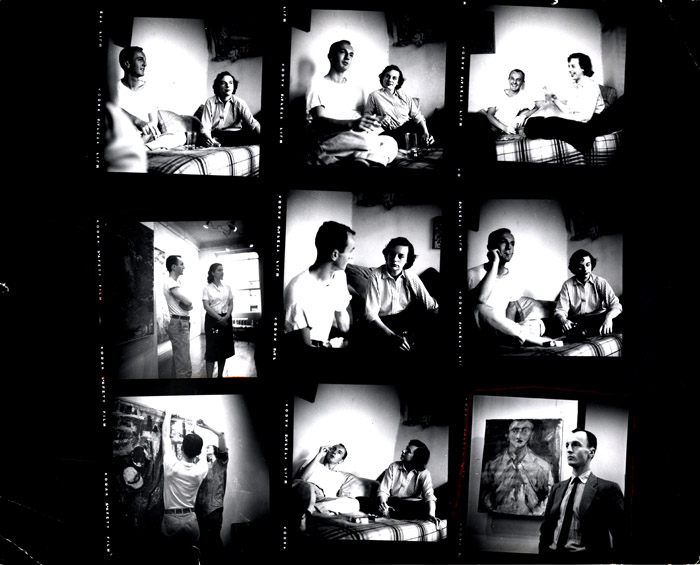
Grace Hartigan and Frank O’Hara
(Photographs by Walter Silver)

Tuesday, July 15, 2008

David Shapiro’s Letters


Brick’d Up

David Shapiro—who turns out percipience with alarming insouciance and innumerable typos (here silently suppress’d) writes regarding Kent Johnson’s remarks pertaining to the authorship of Frank O’Hara’s “A True Account of Talking to the Sun at Fire Island.” I never cease to picture Shapiro as a quizzical kid in horn-rims and crew-neck sweater, still intently studying the tribe, sitting with a tousled Gerard Malanga, intense LeRoi Jones, golden-boy Bill Berkson, skeptical Frank Lima, and atilt O’Hara (the eyes suggesting the pre-speechifying scotch is wearing off) at Wagner College in 1962. How align that against Shapiro’s offhandedly stunning remark in one note about the O’Hara poem—“Maybe the sun itself wrote it, as early photographers used to say about their pictures.” Though I’ve correct’d the typos (often against my purer whimsy—I’d grown quickly to love the unraveling discombobulate texture they lent the “proceedings”), I kept focus’d on Shapiro’s jocular, “edit them and show me, and I would pay you for keeping to my voice not my typos.” First, some lines to Johnson himself:
This letter to you is public. I would really like you to use it whole . . .

I don’t want to say anything crude, because I think your provocations are significant. And I teach attribution and connoisseurship over the last 30 years and it would be a lie to make it seem all trivial. Your work is not trivial. It rouses me like Menard. (I wrote that entire short story when I was only 10—amazing, hunh?)

Yes, reading “Pierre Menard” as an early work of David Shapiro gives a new meaning to Cervantes, to Bolaño who admired my work, and to Pierre Menard who was really the beautiful daughter of Bioy Casares. I met her once, only once, as she worked in a bookstore.

Now dear Kent, remember this:

Kenneth desperately wanted and got a nice cool Ovidian eros in the prose of his essay-poems. And obviously in his late Odes he also invented different tones. But NEVER was the tone of Kenneth close to the lyrical mysticism that concludes the Sun poem. Nor do I think Kenneth needed those special lines about Africa. Kenneth once huffed a bit that Frank was having blues played at a party. Kenneth thought the music was a cliché. I was ambivalent. But I’ve always been pleased that I got around to sending Safe Conduct back, and since that gift, I have bought maybe 30 copies of it on many continents.

Kenneth was Heifetz; O’Hara very early was Menuhin.

Reread Frank’s poems on Mayakovsky, or “Second Avenue” dedicated to Mayakovsky, or poems on Rilke or of Rilke.

It’s Frank who had such a good prose taste. I wish I could show you the people he urged Johns to read—many of them sharp prose writers. His particular prosey elegance comes out of an utter knowledge of the pressures of poetry and prose.

What would be interesting would be a good essay—still doesn’t exist—about the wild differences between, say, Kenneth and O’Hara. I’m willing to write 500 pages if interviewed.

By the way, did you know how much of Whitman is from Emerson: same reliance on the aphoristic; huge pantheists in love with Spinoza; and two who almost acknowledge the crime. Oh Ern Malley! Oh Spectra Hoax! Oh “Mending Sump.”

Did you guess that a lot of H.D. comes out of Duncan AND Aldington at different times? It’s all the topic in Santa Fe.

David
Ludic twistiness of the who’s zooming whom cavort and logroll? One wonders. After I ask’d Shapiro if I could post the remarks above, he wrote to me (dated 13 July 2008):
John, I’ve had almost less than an electron of time to say hello. Kent has made me aware of his position for a long time of teasing the attribution of Frank’s poem. One day I wrote him about 10 letters with remarks on connoisseurship and other matters. And I hear arguments made that I am very skeptical of, even on both sides. But one day I hope to be brave enough to call you and just tell you some things I think, or if I have time to be a writer—typos become my disease in the letters to Kent—he accepts them—anyway, I don’t want to embarrass you. But just secretly know that

1. The poem to me needs 50 more perspectives before I think it by KK or anyone else.

2. Having known this poem for more than 30 years and teaching it beside other O’Hara poems, with their constant development, is utterly convincing.

3. Talking to the Sun would be extremely unKennethy to hold in confidence over the world. If KK had written one of the 100 greatest poems of American history, he in no way would have treated it as a Frank poem. He revered Frank and also knew him fraternally eternally. All this is assertion but by one who knew both and memorized their tones.

4. Aside from agnosia, most of us recognize certain faces and tones quickly. For example, is it Kent who says there is no other poem with the mysticity of this. Not true. “To the Harbormaster,” one of the best and most mature of the early works, unless you dwell too much on Larry Rivers’s penis as Polish rudder, which no reader must know. “To the Harbormaster,” I again say, is like a terrifying elegy of fate and drowning, sad as Johns’s “Diver”: “And, if it sinks, it may well be . . .”

I won’t [go] over it but those waves are very much or exactly like the tone of Frank in “Talking.” Kenneth didn’t use this self-destroying tone, he mocked me for it, and Frank said he called a James Dean poem (the one in the Allen) sentimental. When Frank liked a love poem of mine to a girl, where I changed “To Betsy” in the title to “Elizabeth” in the first line, Kenneth said to me: “Frank’s all heart and I’m all art.” Not true, but the greatness of both is in very different tones. Kenneth didn’t like collaborating with people if their tones were too close. He told me again and again.

5. Mayakovsky is part of Pasternak’s vision and Frank’s for their whole lives. Look at all the references in and throughout Frank’s poems.

6. Anyway, I can produce maybe about 1000 more strong points for this as a great poem by Frank. If the controversy makes more people read it, great and good. If it makes many think that Frank’s poetry is like a Spectra Hoax, that is sad. I argue this with Rembrandt scholars who think Rembrandt couldn’t have used that much red or didn’t do The Polish Rider.

7. As I also think: Kent is a master of proposing situations where certainty is not utter. So are most murder cases unsolved for years. But walnut in a simile is more KK than anyone in the world. Mistakes are made. Good critics are needed. A poem of my own, titled “A Heavenly Humor” in Poems from Deal, was found in Frank’s desk and thought, until I made a correction, to be by Frank. It was published as a Frank masterpiece when frankly it was imitation of Ashbery and just in Frank’s desk. One can’t begin to be precise said Whitehead in a way that is beyond the question’s purview. We will never possibly know whether Shakespeare wrote Pericles, but it gets much better when he seems to have come in. And the Hamlet—what great other poet painted that?

Love to you.

If this wants to be published and you’d be willing to edit it, it would be at least a squib on the question.

Now I sleep. You could ask Kent for say the last 10 of my fragments on this and maybe edit them and show me, and I would pay you for keeping to my voice not my typos. I am drowned in work but I’m sure are.

Let’s ascend together.

Look at his poem against V and Yevtushenko where he appeals to Mayakovsky and the sun. And hates them for revising the revolutionary spirit of Pasternak and Mayakovsky. Frank’s first gift to me was Safe Conduct and its wild images to the death of Mayakovsky. As when he sees his life walking down the street and near it the State.

Frank came by, took my life down from the shelf, and blew the dust away. He is as good a poet as Lorca and I hear him in every syllable of his poems, even despite other qualities, and in his great poems his voice and intelligence are never distant. His “intimate yell” is like Mayakovsky’s if a fortissimo becomes a piano. If only any of us could have written at that level of plainness and adornment, better than Lawrence. If only . . . but we are lucky to have known Frank at all.

Certainty of which Whitehead said: there can be false precisions. Don’t ask me how I know your E-flat is terribly sharp. By the way, Meyer Schapiro’s trialogue with Heidegger and Derrida covers much the same territory. But Meyer is treated very whimsically. Read all of his work to note the delicate balance between skepticism of certain dogmas and his enthusiasm for the genius (still using that word) of the irreplaceable artist. Let’s find out everything about the poem, particularly if it leaves us loving the poem that much more and seeing its qualities. This was a theme in all of Meyer’s work. We shouldn’t be like Berenson and make authorship seem like a good financial transaction. I have enjoyed the taste from some of a true investigation of tone. Without agnosia, I proclaim that I see Frank’s face in the “Harbormaster” and “Talking.”
It’s Monday evening and there is Shapiro’s Monday notes to go and I am both completely put into a trance by the words and uncertain whether permission is clearly there to post. Another list, received 14 July 2008, in a note identifying such as “ten nuances on a sunbeam.” “I you think they might help,” Shapiro adds, and admits “I’m isolated as a Luddite.” He titles it “A New Account of Frank O’Hara Writing in the Sunlight”:
1. I have heard that some people don’t believe the end of “Talking to the Sun” is like any other in Frank’s work. It’s true that every masterpiece is a new genre, as has been said many times. If you find things in Hamlet not found anywhere else, it is not the time to make a de-attribution. Anyway, here’s a convincing (for me) counter-example: the end of “To the Harbormaster” is full of mysticism, proleptic, prophetic diction (forget the rudder as Rivers’s penis, Frank didn’t beg for that reference at all). “and, if it sinks”—how much closer can we get to that mysterious “they” than the waves that keep us from hearing Frank hearing.

2. What about KK and his imaginary poets? . . . Kenneth, as many know, loved to parody, imitate, and pay homage all at once. But he never produced one character that I ever had the smallest second of trouble over hearing Kenneth making the imitation. He taught imitation as a teacher at Columbia. But he never told me he liked faking a poet—he did love the mixture of truth and illusion in Borges, but actually was fairly conservative about his taste for hoaxes, literary or bulletproof. The LeRoi poem sounds more like a KK parody.

3. The tone: If the people who heard in viva voce were gathered—and I speak to many—not one will challenge the tone of this as Frank. Kent once asked me if he ever had such lyrical programme of dialogue. Well, he even has two avenues talking to each other. Very like.

4. Diction: I can only see Frank and not even a genius imitator alluding to ghettoes and tundras, Africa, etc. This is the poet who spoke to me always of political matters.

5. If. If KK, as I knew him every day for maybe 20 years or so, and twenty when it wasn’t every day—KK is in no way the poet who would have written the masterpiece, one of the ten best poems in the American language, and said it was Frank’s. He was very tough about credits to himself. He signed, after all, his imitations. They were HIS shtick. Signature, if you could find it, would be important. The fact that we have not yet seen the original typescript doesn’t make me feel any better about being skeptical. Quite the reverse. It’s up to the skeptics to tell me who really wrote Hamlet—some other greatest poet who never did it again . . .

6. It is true that after Frank’s death Kenneth sometimes tried a poetry of the personal (“To Marina”) that was heartbreaking. But even with references to Frank and maybe as it were reference to his “style,” I have never thought for one second of those poems, “Circus II,” say, and others of nostalgia and friendship—never is there a doubt of hearing Kenneth speak.

7. Biographies are almost always false. The reason? A hundred, but one is that it is very hard for biographers who have never interacted with the person to pick up the thousand cues that make a person and a style. I find LeSueur very close to aspects of Frank’s tone, and why shouldn’t he be? He lived with Frank and knew his tone by heart. I tried over 5 years to memorize everything he told me, as I did Johns and just a few others. If someone tells me the tone of Frank is not within the passage about free embrace and appropriate embrace, ridiculous. It comes out of love for Lawrence.

8. If anyone is amazed by the Mayakovsky image, what about the fact that Frank gave me Safe Coinduct, great Pasternak ode to Mayakovsky and his death. Also, that there are many other references to Mayakovsky, one being the immense putdown of Yevtushenko and V: Mayakovsky’s hat worn by a horse. I will eat a Mayakovsky hat as salad if that isn’t an O’Hara topos. Also, for those who don’t read as carefully as Frank should be read, the last lines of that poem are all about the energy of the sun, the red sun of Mayakovsky and a definite allusion for anyone awake to the “Account.” Kenneth always told me that Frank was like a revolutionary (maybe without a war, but) and Mayakovsky was the perfect poet of the heart.

9. There are many discoveries to be made—I recently found that one of Frank’s poems about Dean, was almost a line for line homage to Rickert’s song, “I Have Lost Touch with the World.” I have told this only to a few people. It’s in a way like finding a new kind of masterpiece—and yet isn’t this homage to Mahler, and Rickert, etc., exactly like the homage to M in his counter-irritant “Talking.” It’s not in the new Selected, but I think everyone can find it as one of a sequence of poems. Jarmusch (my wonderful ex-student and now master) put in the melody of Mahler into the last act of Cigarettes and Coffee, and presumably Phil Kline of Columbia suggested the music to him of Baker singing. I find that Frank’s sister speaks of his love of Mahler, and I found at least one allusion on the internet to a dance that Balanchine seems to have done to the Rickert lieder.

10. Frank should never be seen as the mere expert of I do this I buy that. The joke used to be that that was him and I am this I am that was JA. It is many times more difficult. There is the dedication to Mayakovsky of “Second Avenue,” or am I doddering. There is the great Dean ode from the Allen Anthology now not placed in the Selected. It’s true that I loved it at 13 and Frank told me he was glad I did, because Kenneth had called it sentimental. When I mentioned another love poem of mine that Frank liked, Kenneth said: “Frank is all heart and I’m all art.” Not true, but I find it impossible to believe that Kenneth’s tone is in “A True Account.” Does anyone suppose a Jimmy Schuyler poem about a rose was also written by the flowery Kenneth? Ridiculous. Certain tones are shared by Frank, and KK, but not in the “Talking to the Sun.” And of course I agree that the person in connoisseurship who doesn’t accept the authorial norm—that person has a tremendous onus to prove it if thousands have not seen it. I remember Meyer Schapiro giving a long lecture on method and being a bit amazed at the positivist beginning: first to try to be sure of dates and authors and artists. In this case, and this is not the Kennedy assassination, it is a very great poem whose tone, construction, topic, discovery, etc.—are all rather convincing. The idea that the story is weird doesn’t seem a true account to me.

RSVP: Here’s another problem. Because Kent has made one of his great provocations a topos, that is, he loves and I think he has there right as in any fiction to provoke others through skepticism. But if I take him philosophically and poetically at his word, I would call it “false precision,” when he doubts, and a lot of almost Derridean extremes in his contest of wills. I worked with Derrida, and he actually and finally came out of his neo-Nietzschean corner and believed in radical refuge, forgiveness, etc. I hope poets can realize that those who fight over attributions are not all knaves and slaves to an idée fixe. But it is also true that a person who finds a Stradivarius in the morning labeled John Doe, should be less believed if he finds a great poet in an atomic attack speaking of Spicer. I remember loving the poetry in APR and being very vexed over the allusions. And I know my own poems came out of a desk of Frank’s and were thought to be by him. But, but: If you find a Leonardo in the morning, and all his swains commend it, you better have very strong reasons to tease me about the Giorgione you found at Cooper-Hewitt Museum later in the afternoon.

Some art historians are called enlargers, some shrinkers. I’m balanced enough to know lots of fakes come in the Met’s door and stay. But if a person has made their living from de-attributing, we have to think that as in Borges, Bolaño, and Pierre Ern Malley himself—it is the negative that is hardest to prove.

First Kent said he couldn’t find an early transcription of the poem. Then he did. Then I hear he thinks or others the ending is unique. The vessel sinks.

I think we all owe a debt to the skeptics, but they must find some time to retreat from Shakespeare-as-Bacon arguments and let’s also return to loving the density of the masterpiece, which for me and teaching it for 30 years at Cooper Union and Columbia—I find to be as strangely beautiful as anything in Rauschenberg and Johns—two whom we also ought not to blur. Roommates do not always end up collaborators.

A person told me once that he had dialed Dial-a-Poem and gotten Frank’s voice, though Frank was dead. The voice was so obviously Frank’s that the person had to shudder at the living dead. I love John Forbes for saying that he had a dream in Australia that Frank was dead but still writing poetry. He says in his poem something like: “What a guy, dead and still making new poems.”

Who killed Frank O’Hara? No one could, even with their shriveled arrows.

Who tried to keep on the outs? You know all the louts.

Who tried to sneak him in? The joking genius djinn.

Who tried to kill you, Frank?

Like Joe Hill, I’m still alive, Frank said. I can die and write as well, etc.

And here in this wretched anger, I am not speaking of Kent.

Let our common monument be poetry built in battle (allusion to M.)
How, wholly unintentional, one supposes, the reiterations (variations on a theme) mimic those of Kent Johnson’s “Reply to Tony Towle . . .” How breathless it all makes me, for David Shapiro is “all heart.”


That done, the gears beginning to grind in the posting machinery, I receive a late addition (15 July 2008). Shapiro writes:
And enfin, I called Maureen, O’hara’s sister, and she told me she had a letter from Frank that might solve all the chatter about whether he wrote the poem or not and when.

She read from a letter that is dated immediately after the weekend spent with Hal Fondren. In it Frank is terribly witty and proposes that they start a gallery together, which would be less physical effort says O’Hara but bound to . . . fail. He ends the incredibly sweet letter of thanks with a smoking gun report: He has forgotten to give the poems that he wrote at Hal’s to him. Two poems are enclosed. Maureen has the letter but not does like to enter controversies. The wittiest part of the letter, which Kent and others can love, is the statement that these poems might be corrected here and there but maybe, he says, maybe Hal will want to do the editing himself, for his greater reader’s pleasure.

The poems weren’t written by Hal. They were written by Frank O’Hara. They didn’t mysteriously appear in 2008 or in 1966. “A New Account of Talking to the Moon” by me will follow me one day. Of course, instead of believing me, some will have to write to Maureen Granville-Smith and, if she pleases, hear or read this dazzling letter. Few will want to make any changes on True Account(s).

PS: And what is the truth in poetry? Even a poem by me looked to some like a Frank poem when it was discovered in his desk.

Be careful when you take down one’s life from the desk and think you blow the dust away.

Pierre Menard did NOT write more than a sentence of Don Quixote.
Whew.

Gerard Malanga, LeRoi Jones, David Shapiro, Bill Berkson, Frank Lima, and Frank O’Hara at Wagner College, 1962
(Photograph by William T. Wood)

Monday, July 14, 2008

To the North, & Back


A Wall

“What to do / when the day’s gaunt orbital codex / slices through night’s dauntless and Nembutal’d cortex / in a wake of an impertinence . . .” Sunday one launch’d oneself “to the north”—four hours driving to a drop-off, four hours back. A funny excursus. Looking for a stretch along U. S. 127 where the Maple River’s all floody along two sides of a low bridge: usually there’s a half-dozen or so egrets tilting out of it, all perfectly angled, leaning white spikes. “I count on it.” Popping Dylan into the box, thinking about how he, like Ashbery, pulls down the oddball American demotic off the airwaves: “If you don’t believe it you can follow your nose.” Or how he crams a line fat, too fat, excess vocables requiring a mean enunciatory vigor—“Romeo, he said to Juliet, you got a poor complexion that don’t give your appearance a very youthful touch. / Juliet said back to Romeo, Why don’t you just shove off, if it bothers you so much.” In the drifty back canyons of my brainbox—a scratch of thinking about long-lined-ness, spur’d partially by a look at Charles North’s “Schuyler’s Mighty Line” wherein he notes “the advent” of Schuyler’s “exceptionally long line” occurs with the appearance of “The Morning of the Poem” in 1980. I read that just after seeing Charles Wright talking in an interview about trying to stretch the line out longer and longer to see what weight it’d carry (and how it’d snap off, making drop’d down half-lines). (Elsewhere he talks about “applying” lines like paint, using color and form to delineate the shape of an area, after Cézanne: “What I was interested in doing was relaxing the line, using the line more as an overall unit in the poem rather than as a bridge from one part of the poem to the other—as one bridge to another bridge to another bridge. In other words, the lines in the stanza are applied, in a way, rather than narratively leading from one thing to the next.”) He pinpoint’d that experiment’s being 1977 (and continuing): on the heels of the severely cut back, stripped down (never so short’s Shuyler’s though) lines of China Trace. The nigh concurrence of dates: what—if anything—to make of it. Thinking, too, of C. K. Williams’s long lines (beginning with Tar (1983)—and of some of the San Francisco contingent of language writers pushing the line out and out (or into prose), même “era.” A. R. Ammons’s long-lined longer pieces predate some of that—Sphere: The Form of a Motion is 1974. So do, of course, Ginsberg’s “Howl” hanging catalogues—though there, something like “who chained themselves to subways for the endless ride from Battery to holy Bronx on benzedrine until the noise of wheels and children brought them down shuddering mouth-wracked and battered bleak of brain all drained of brilliance in the drear light of Zoo,” isn’t consider’d a line so much’s a breath, a “heave”—there’s no attending to its breakage or not. Similarly, Sphere’s basic unit of construction is the three-lined stanza:
                mind, many-sided, globe-like,
rich with specification and contrariety, is secure from

slogans, fads, starved truths, and propaganda—defeats itself,
meanwhile shoring itself up with sight and insight: how to
devise a means that assimilates small inspiration into to

large space, network, reticulation complex (almost misleading)
but moved forward by a controlling motion, design, symmetry,
suasion, so that harmony can be recognized in the highest

ambience of diversity

What if one consider’d a series of imaginary allegiances and alliances “based” on the superficies of line-handling (sounds rather athletic, no?) Wouldn’t that make Schuyler and Wright coeval? So it goes, driving. The undamp’d patter of battery of ruminating—interrupt’d by impingements, sonic, visual. The great blue heron trailing its legs, the scatting meadowlark’s white coverts flashing as it erupts out of the median. Or Ray Charles saying to Marian McPartland that some other’s’d see the songs he loves as “antiquated” because the lyrics tell a story. And proceeding to growl out “The corn is as high as an elephant’s eye . . . All the cattle are standing like statues” out of Rodgers and Hammerstein’s “Oklahoma.” Back, the high shreddy clouds of the nadir blushing with peach highlights pick’d up off the west’s fiery underbelly. I would never write my sublime essay about line-lengths. I start’d a poem call’d “The Mandarins” beginning “Stealth, like a shit, stole through the streets,” and stop’d.

Charles Wright

Friday, July 11, 2008

Some Turns


T-shirt and Hydrant

Andrew Epstein writes (9 July 2008):
Dear John,

After reading Bill Berkson’s letter to you, in conjunction with Tony Towle’s letters, it seems clear to me that my attribution of “Finding Leroi a Lawyer” to O’Hara has provoked strong, skeptical reactions from some people who were very close to O’Hara himself, who know his work better than anyone, and whose judgment I respect enormously. I am certainly not inclined to insist on an addition to the O’Hara canon which has raised such doubts from close associates of O’Hara himself.

Just to explain the context: in the course of my archival research for a book about friendship and postwar American poetry, especially in the work of O’Hara, Ashbery, and Baraka, I came across a document that was in Kenneth Koch’s possession, that he gave to the Berg Collection at the New York Public Library, in a folder of O’Hara materials (filled with letters and poems from O’Hara himself, and other miscellaneous O’Hara-iana). Although it was not signed by O’Hara, there seemed, to me, a good deal of internal and external evidence it was by O’Hara himself and simply no indication it was written by anyone else (I’ve explained some of my reasoning in previous posts on Isola di Rifiuti). My decision to attribute the poem to O’Hara was made in good faith and based on what I believed to be valid reasoning. However, after hearing these responses from Towle and Berkson, I recognize now that I may have been too quick to make the assumption that it was by O’Hara. I still can’t help wondering, though, if the poem is not by O’Hara, then who did write it and how it ended up in Koch’s O’Hara materials.

Thanks to all for the very interesting discussion.

Sincerely,
Andrew
In lieu of commentary (and in genuine appreciation and thanks for all who wrote with perspectives wild, surmised, untenable, or fully-wrought regarding the authorship of the poem) I think only of René Daumal’s terrific little ditty, Cent cons m’enterrent / sans commentaire. Loosely, “One hundred idiots bury me / with nary a commentary.” (I only say that in order to put myself in league with those who defer to authority anywhere—it’s my nature. I’ll cheer for the Chicago Cubs only up to the point they begin regularly knocking the ungodly white orb into whatever smithereens the neighboring vicinity houses, winningly. En ce moment-là, I root for the others, the lowly contenders. Donc, how indefatigably and relentlessly I turn to the O’Hara of
        My eyes are vague blue, like the sky, and change all the time; they are indiscriminate but fleeting, entirely specific and disloyal, so that no one trusts me. I am always looking away. Or again at some thing after it has given me up. I makes me restless and that makes me unhappy, but I cannot keep them still.
Turning to what steadfastly thwarts any alignment by moving away. High apolitical dudgeon. In 1949, O’Hara had a course at Harvard with Renato Poggioli, “Theory of the Advance-Garde Art”—Poggioli testing out the crux of what’d become the 1962 book, Teoria dell’arte d’avanguardia. Poggioli trying to duck out under a tangle of barb’d wire that historically align’d the avant-garde with political radicalism. A neutering. Is it there that O’Hara’s “stance”—so ably and memorably delineated by Ashbery in 1966, “Frank O’Hara’s poetry has no program and therefore cannot be joined . . . and is thus a source of annoyance for partisans of every stripe”—is found’d? Or is it “merely” temperamental—an impetuosity, a rush that cannot be slow’d by joinery? (I think now of Renato Poggioli, whose book I may’ve gander’d at in my scuffling days, and it is the happy frisson of Sylvia Poggioli’s NPR sign-off, pronouncing “Poggioli” with a hint of something chewable in the double g that serenades my poor dark brow, collapses my bright construct, turns me elsewhere, attending.) That is how it works.

For the “slow poetry” regenerates—isn’t the danger in relenting (whilst the brute agon of the moment charges forth endlessly, oil or no oil) a falling into mere “generalizing” thought? See Olson’s “Human Universe” distinction between “language as the act of the instant and language as the act of thought about the instant.” Where goeth the “MOVE, INSTANTER” under such? The percept’s got to splice the air forking (making its own path) like lightning, with lightning speed. (Of course, if one’s talking about grabbing up detritus off the public roadways and jigging it about in some jerry-rig’d simulacrum—that’s not writing anyhow. That’s Lego-work.) (Of course, if one’s talking about printing books, “that glut,” sure. My “policy”—so precisely’s I am able to accountancy it—is, roughly one book per quarter century. Rubbing Torsos, 1979; Breeze, 2003. That ought to be sufficient for anybody.) (One note: that “SloPo” monicker rather deftly defeats the intent—abbreviatory mangles signal a corner’d market and empty into the dirty stream where conservation’s no longer stung by the archaic (“the impulse to recover beginnings and primal energies”), that ethical center of the modern; “besides, they are ugly.” One’d do better with something like “lackadaisical verselet-ing.”) I start’d a piece call’d “The Poppies” that went “contend against local breezes, little juggernauts / of the indistinct . . .” and stop’d.

René Daumal wearing paroptique glasses.
(René Maublanc’s 1920 book
La vision extrarétinienne et le sens paroptique, proposed the theory that if the eyes were closed, a kind of vision could be developed in the epidermal cells of the fingers. “Maublanc would put Daumal into a light state of hypnosis during which Daumal was able to describe objects in a specially covered box, or the images of book covers. He could differentiate colors by the sensation of heat and cold that he absorbed from different hues.”)

Thursday, July 10, 2008

Kent Johnson’s “True Account”


Blue Scrim

Gadfly par excellence (if one measures the species by how regularly it irritates, or causes hysteria-fuel’d blinding rashes to erupt around the eyes of the prematurely “set,” the self-satisfy’d, the in-need-of-a-downpegging), cogent and sure-finger’d provocateur particularly at home amongst the “post-avant”’s most cherish’d and shibboleth-bound sentries and soldiers, buster of all institutional sod-bodies, be they man, beast, or edifice, Kent Johnson’s exercises in point’d authorial malarkey’s earn’d him not a few snarls of dismissal and loads of pettifoggery. At heart, though, he’s a kind sort, good-natured and -humor’d, darkly in love with all contradictory lapses and the too many human, too human foibles. He reminds me a little of the Akhaian warrior-girl Kinētikos Philoctetes who, mortally wound’d by the sight of the slaughter of comrades, her own dark blood easing out drop by drop into the Trojan sun, remark’d without rancor or puffery, “Wisdom dies in the plain.” Though some say her servant-girl, mad with premonitory grief, misheard the words (the mad battle’s tumult sketch’d its merciless designs unceasingly around about as the two great opposing armies look’d to “settle” some unsettleable accounts). They say what Philoctetes actually said—feverishly studying her renegade blood’s fatal pooling—is, “Wisdom lies in the plain.” Today, exactly fifty years after the writing of O’Hara’s stupendous reply to Mayakovsky, “A True Account of Talking to the Sun at Fire Island,” Kent Johnson considers the poem’s strange authority and provenance in a reply to Tony Towle (and others) and a reposting of a “tape-essay” by Tosa Motokiyu. It is an oddly moving piece—both a “quasi-fictive” critical romp and a perianthic meditation on loss: “isn’t it strange how we abandon without explanation those who are so close to our hearts, those who intrigue us most?”


A Reply to Tony Towle (and Andrew Epstein and Bill Berkson) on the Subject of the Authorship of “A True Account of Talking to the Sun at Fire Island”
Sometimes it seems to me I am possessed by the
spirit of Frank O’Hara and should write his poems
as he would have written them now but
the only ones I know are ones he’s already written
and those are what these turn out to be.
—Kenneth Koch, from “Homage to Frank O’Hara”
He falls; but even in falling he is higher than those who fly into the ordinary sun.
(The only entry in the new journal Frank O’Hara had begun soon before he was mortally struck, and which apparently fell, along with most of the poet’s manuscripts, into Koch’s possession shortly following O’Hara’s death)
Tony Towle has termed “absurd” Tosa Motokiyu’s hypothesis that Kenneth Koch is very possibly the true author of “A True Account of Talking to the Sun at Fire Island,” a poem near-universally regarded as one of O’Hara’s greatest works, ever since Koch “discovered” it in 1966. Andrew Epstein, similarly, has called Motokiyu’s proposal “bizarre.” Bill Berkson has weighed in, dismissing it as “folderol.” (See my note at end on Berkson’s claim that his “distinct” memory puts the issue “to rest.”)

Well, it’s a formidable group of dissenters, to be sure! I greatly admire the poetry of both Towle and Berkson, and Epstein’s book on O’Hara, Ashbery, and LeRoi Jones / Amiri Baraka, Beautiful Enemies (Oxford, 2006), is one of the most engaging works of literary criticism I’ve read in a good number of years, so my argument here is with people I sincerely respect. And it is true, I readily admit, that an application of Occam’s Razor to what we know leads one to lean towards the conventional attribution—one I personally hope is soon definitively settled in favor of O’Hara; nevertheless, unusual gaps with strange questions remain. These gaps and questions are bibliographically, as it were, interesting in their own right, and I am going to offer some reasons, then, for why—at least for now—the proposal of a possible Kochean authorship is really neither “absurd,” nor “bizarre,” nor a piece of “folderol.”

In doing so, I’ll quote Tony Towle’s letter in full (as it appeared here at Isola di Rifiuti on June 11) and respond to each paragraph. I’ve put the passages from Towle’s letter in bold, below. Because Almost Island—the New Delhi magazine where Motokiyu’s tape-essay recently appeared—is currently off-line in preparation for its second issue, I have asked John Latta to append a copy of Motokiyu’s text beneath this response. Towle begins:

Dear John,

Your offhand comment about Kenneth Koch on April 25th in Isola di Rifiuti has continued to bother me and I must say something about it. You wrote: “(. . . I suspect the piece [re: some lines of Frank O’Hara’s] is just another [. . .] later intercollocation to the Collected by the dapper and dement’d Kenneth Koch.)” Now, Kenneth was usually well dressed, in a professorial kind of way (he did teach at Columbia), but what causes you to characterize him as demented? Perhaps you are confusing extravagant imagery with the personal character of the poet—because I knew Kenneth for almost 40 years and he was one of the sanest and most cogent people I have ever met, brimming in equal measure with common sense as well as erudition.


Sanity, cogency, common sense, and erudition, I trust, are qualities that could well inform a person who might choose, for any number of possible reasons, to write under the name of another. Not a few sane, cogent, commonsensical, and erudite writers have done so, over the centuries. It is a venerable part of the literary tradition, and Koch, as is known, held various examples of pseudoepigraphy in high regard.

You seem to be taking it as fact that Kenneth wrote poems and passed them off as Frank’s. This is a ludicrous and untenable assumption. The “Leroi [sic] Jones” poem found in Kenneth’s papers, and that you discussed on your blog, may or may not have been Kenneth trying out a poem in his friend’s style but, after all, it was in his papers, unsigned—he didn’t try to pass it off as Frank’s. And though it’s clear to me (for the reasons I gave you after you printed it) that this could not have been a poem of Frank’s, it is by no means certain that it is Kenneth’s, either, regardless of where it turned up. In fact, when Kenneth tried to imitate Frank, in a series of nine poems under the heading “Homage to Frank O’Hara,” published in Broadway 2 (Hanging Loose Press, 1989, James Schuyler and Charles North, editors), his style is most unconvincing. I would be happy to type these up for you (they are quite short) and you can judge for yourself Koch’s ability to take on at will O’Hara’s manner. This brings me to your link.

As it does me. Though a fascinating case, the ”Finding Leroi a Lawyer” poem is not central to my purposes here . . .

The another leads to a clever in parts but absurd document that you seem to endorse by default, the thesis of which is that Kenneth Koch wrote “A True Account of Talking to the Sun at Fire Island” after Frank’s death (July 25, 1966), passed it off as Frank’s when he read it at the first posthumous memorial reading for O’Hara, held that September in the auditorium at New York University’s Loeb Student Center, where Kenneth and John Ashbery read Frank’s work. The argument is set forth in a presumed tape transcription by a Tosa Motokiyu, who may or may not exist, talking about it with two friends, who may or not exist, and transcribed by Kent Johnson, who definitely exists and who seems to have a penchant for inventing texts in English purportedly from Japanese writers (as per the endlessly discussed Yasusada affair).

The thesis is, indeed, that Koch might have written “A True Account of Talking to the Sun at Fire Island,” and that a bundle of curious circumstantial evidence makes this a provocative possibility.

However, as is stated in the essay, and has been acknowledged for some time, Ojiu Norinaga and Okura Kyojin are heteronymic collaborators invented by Tosa Motokiyu, the pseudonym, in turn, of the author, or authors, of the Yasusada works, as well as of various “tape-essays” on different topics, the latter which stand now, ipso facto, as quasi-fictive critical pieces. I would note, then, that the manifestly apocryphal status of Motokiyu’s work, about which Towle appears to have some confusion, is irrelevant, ultimately, to the legitimacy of the hypothesis the tape-essay puts forward.

Motokiyu supposedly quotes interviews from Joe LeSueur and Kenneth Koch from 1990, when Motokiyu was in New York, and he has LeSueur more or less agreeing with him that Frank couldn’t have written the poem. I was one of the many audience members at the NYU reading that was blown away by the beauty—there is no other word for it—of “A True Account.” No one had the slightest doubt at the time that Frank had written it—it was quintessentially him.

To repeat the tape-essay’s claim: Motokiyu, at a meeting in NYC with Joe LeSueur (O’Hara’s long-time roommate), tapes the latter’s comments on the matter of the mystery of “A True Account,” which LeSueur, subsequently, with aid of the transcript, transcribes, nearly verbatim, into his memoir, Digressions on Some Poems by Frank O’Hara (FSG, 2004). Motokiyu doesn’t, in this sense, have “LeSueur agreeing with him”; quite to the opposite, LeSueur’s marked, authentic puzzlement [see Digressions, pp. 180-190] over the poem’s origins form the very basis of Motokiyu’s speculations about its actual authorship.

As to Towle’s claim—and it is a moving one—that everyone was “blown away” by the (unquestionable) beauty of the poem and that it was “quintessentially [O’Hara],” I would offer two comments: The first by way of Brad Gooch, author of the O’Hara biography City Poet (Knopf, 1993), whom Motokiyu also quotes. Gooch says,
[T]he poem had been written by O’Hara on July 10, 1958, when he was visiting Hal Fondren at his rented house at Fire Island Pines, not far from the spot where he would be hit almost exactly eight years later. The poem consists of a conversation between the Sun, who wakes O’Hara and complains petulantly, “When I woke up Mayakovsky he was / a lot more prompt,” and the apologetic poet’s comment, “Sorry, Sun, I stayed / up late last night talking to Hal.”

“I almost fell off my chair,” remembers [Kenneth] Koch. “It was Frank talking about his own death.” In the following months, Koch often read the poem at poetry readings to audiences who were invariably moved by its almost too neatly prophetic parting stanza . . .
[my emphasis]
It seems to me perfectly understandable, given the emotion of the event, combined with the uncanny, almost “too neatly prophetic” tone and eerily coincidental mise-en-scène of the poem (the setting of it, again, is in the same location where O’Hara was tragically struck, almost precisely eight years after the composition date), that people would be “blown away” and unquestionably accept the poem as O’Hara’s.

But is the poem “quintessentially” O’Hara? In fact, though there are extended poems of like greatness and others with dialogue, “A True Account” has no real analogue in his work. What poem in his oeuvre truly echoes it, in mystical conveyance, dramatic presentation, transparently staged derivation, hallucinatory, over-the-top pathetic fallacy, and so forth? Towle’s logic here seems shadowed by a circular, wishful impression, though it’s not one for which he, or anyone, can really be blamed: For that the poem sounds “quintessentially” like O’Hara is largely due to its existing, since 1966, as one of “O’Hara’s” most powerful, weirdly prescient, and singular poems!

Everyone was definitely amazed that he had never published it, but, in 1971, everyone was further amazed by how many poems he never published, and how many that no one had ever seen, not Joe, not Kenneth, not John, not Jimmy, not Bill, not Ted. This casualness about his work was one of Frank’s salient, perhaps defining, idiosyncrasies.

Of course, his idiosyncratic casualness had more to do with tossing his poems around to friends, even giving them away, and most of the “unknown” poems had been put, through casual circumstances, into acquaintances’ hands by O’Hara himself, not concealed from the world. (“Ode: Salute to the French Negro Poets,” it’s interesting to note, apparently written during the visit to Fondren’s house, with date of only one day previous to that of “A True Account,” was quite famous not long after its composition.) In any case, there is no poem that “no one had ever seen” that compares in any way, in scope or apocryphal status, to “A True Account.” As LeSueur says in Digressions, it is a “real mystery” that no one ever knew of the poem.

And especially, perhaps, not Ted Berrigan, whom LeSueur reports often came, during the 60s, to his and O’Hara’s apartment to pore over the master’s manuscripts—the same manuscripts which Koch, as a matter of record, spirited away in suitcases only hours after O’Hara’s death, and within which the poem was supposedly found. How is it possible that Berrigan, crazy about O’Hara’s work as he was, would have repeatedly skipped over this sui generis text in his study of O’Hara’s manuscripts—or perhaps have read it, since he apparently read everything by O’Hara he could get his hands on, but then have completely forgotten ever having done so? I’d propose that this is an important question. (I will stay agnostic here: Perhaps Alice Notley, or someone, could report a clear memory that Berrigan had seen the poem before O’Hara’s death?)

What defies logic and probability is that Kenneth would have known the exact date of a weekend that Frank had spent at a beach house that Hal Fondren rented at Fire Island Pines some seven years before, and used it as the basis for a fraudulent production he would have had to start on the heels of Frank’s funeral and finish up in five or six weeks. (Kenneth, with his academic credentials, was certainly responsible for the date of the reading at NYU; one would think he would have given himself more time to finish the poem!) Kenneth was not a friend of Hal’s, by the way, and if Kenneth was making up any part of the poem’s foundational mise-en-scène, Hal would have gladly revealed the deception.

Five or six weeks clearly allows plenty of time to compose a poem. O’Hara, so the history goes, knocked it off shortly after waking, no doubt with a hangover.

Furthermore, it would have presented no insurmountable difficulty for Koch to ascertain the approximate dates of a visit by O’Hara to Hal Fondren’s house at Fire Island. Koch, if he didn’t have the visit in general memory, could have learned the particulars from Fondren, LeSueur, or someone else the chatty O’Hara might have called from the location, later told about the visit, etc. The possibility hardly “defies logic and probability.”

What seems to more defy logic and probability is that O’Hara, in the generous habit of showing his poems to his friends, especially those whose names were mentioned therein, would have not shared or ever spoken about the poem with anyone—not with Fondren, who appears in the poem (Fondren, who died in 1999, appears, as implied in Digressions, not to have mentioned the poem to anyone), and not with his roommate LeSueur, with whom he spent the afternoon and evening at Fire Island the day on which the poem was purportedly written (LeSueur, in his memoir, cannot figure out why O’Hara would not have mentioned the poem to him or Fondren; nor when O’Hara, having slept late, would have found the time to write the poem; nor how he could have done so without Fondren or his companion, Jack Shaw, hearing the typewriter).

And, of course, not with Koch, who O’Hara well knew was also enamored of Mayakovsky (it is around this same time that the two were gobbling up and discussing Pasternak’s newly-translated memoir, Safe Conduct (New Directions, 1958), wherein Mayakovsky is somewhat the star)—and enamored, both of them, without question, of the Russian poet’s “A Most Extraordinary Adventure That Befell Vladimir Mayakovsky in the Summer, at the Rumyantzov Cottage, Mount Akula, Pushkino, on the Yaroslavl Railway,” which had appeared in translation as early as 1941 (in New Directions annual, with shortened title) and which is the direct, textually acknowledged inspiration of “A True Account.”

Then there is the matter of sensibility. The matter-of-fact poignancy in “A True Account” is nothing that was a part of Kenneth’s literary repertory at that time—it is not until New Addresses (2000) that he can be so direct and touching. Then there is poetic ego, of which Kenneth had a normal portion. If he could have written something this powerful for such a close friend so recently deceased, he would have put his own name on it and made it an hommage. The notion that he would have spent his literary energy on perpetrating a con, and then taking that knowledge to the grave, is simply not credible.

In fact, one could argue that the tropic fantasticalness of the poem is closer to Koch’s “sensibility” than to O’Hara’s. The touching, quirky poignancy (and wacky personification) of “Permanently,” one of Koch’s most famous poems, is contemporaneous with the given date of “A True Account”; and a major poem like “Some General Instructions,” written just a few years after O’Hara’s death, carries vividly suggestive traces of the Sun’s instructions at Fire Island. Other comparisons, from long before 2000, are possible; others might offer them.

Be that as it may, strong poets are capable, I hope we agree, especially in moments of great emotion and transport, to enter into voices other than their “own,” to write poems that seem to defy a signature style. (One could make this same point in defense of O’Hara’s authorship, actually, though Towle’s argument is the opposite.) Let’s not forget, as well, that Koch, rabid fan of both Mayakovsky and O’Hara, intimate with each poet’s voice, was—it seems to hardly need saying—quite capable of mediating a “meeting” between them.

So no, I am not in any way convinced by Towle’s categorical claims for the irreducible “O’Hara-ness” of the poem.

Now, as for it not being credible that Koch would perpetrate a “con,” I can only say that Towle’s point seems premised on the assumption that acts of radical poetic empathy and transference should be labeled as such. Why frame it as a “con”? Certainly, as a great fan of Thomas Chatterton, Ern Malley, and Fernando Pessoa, for example, or as the future author of the graciously parodic Some South American Poets, he wasn’t averse, in principle (hopefully no poet is!), to the idea of writing “as another.” I don’t at all think it is credible to say that Koch would be incapable of erasing his name in favor of that of his friend and gifting him a poem: After all, he loved O’Hara deeply, and if there is a modern poem that can be read as secretly speaking apostrophic love, “A True Account” is it.

And it is a poem that clearly remained a very personal one for Koch, who reprinted it in various venues over the years, spoke effusively about it, read it widely, and titled two subsequent books from its lines. One might argue he titled three books after the poem, actually: His last, posthumous collection, a gathering of early work he helped prepare, is titled, with somewhat peculiar evocativeness, Sun Out.

But let’s turn to the transcript itself, to the statements that Joe LeSueur as taped by Motokiyu-san is supposed to have made. I won’t bother to list the many unlikely and absurd phrasings that never would have come out of Joe’s mouth; and then there are the casual slip-ups of fact—such as that the Cedar was in the Village, not the East Village, and that July 10, 1959 [sic] was a Friday not a Thursday (the poem was supposed to have been written on a weekend, after all)—however, when Motokiyu calls up LeSueur from a pay phone with the expectation of meeting him that same day, he makes no mention of the fact that he would have had to make a toll call to Suffolk County, as LeSueur had already been living in East Hampton for some years by 1990, a good three hours from New York by either train or automobile, so it would be most unlikely that LeSueur would have said, “Let’s meet at The Cedar at 5 PM sharp . . . but it’s the next phrase in that very sentence that totally uncovers the hoax . . . at the outside tables in the sun,” and so we did. The Cedar has never had outside tables, not in its previous location between 8th and 9th Streets on University Place, and not in the “new” location a couple of blocks north, from 1965 to a few weeks ago, when it closed its historic doors. The purported interview with Kenneth Koch is also patently bogus, for reasons I will tell you sometime if you are still unpersuaded.

I’m afraid it is LeSueur, in Digressions, who reports it was a Thursday, so perhaps Towle was looking at the calendar for, as he has it, 1959? Regardless, and tables outside The Cedar, or not, the tape-essay in which Motokiyu makes his argument, as explained above, is of openly distressed authenticity, a factual fiction (Motokiyu’s admiration for David Wilson’s ongoing art-in-life masterwork, The Museum of Jurassic Technology, is a matter of record), so the points made in this section of Mr. Towle’s letter are not really relevant to the discussion. The fictive mode is simply the expression of Motokiyu’s own idiosyncrasies—though one might see how the mode is appropriate, ironically or not, to the topic.

Whether a Mr. Motokiyu fabricated the entire text in Japan, or (much more likely) a Mr. Johnson invented them in the Midwest, these interviews obviously have no more historical reality than the hypothesis has validity.

To the contrary, given the “bizarre” genetic issues at play, the hypothesis has tantalizing validity. It proposes a possibility, one supported by a number of decidedly odd and frankly suspicious circumstances surrounding the poem. We have this ”too neatly prophetic” text, let’s not forget, on Koch’s authority alone. He (somewhat in the manner of the Yasusada texts, in fact) “discovered” it.

By baselessly muddying the waters of the authorship of “A True Account,” whoever perpetrated this irresponsible prank has done a disservice to two major poets—he has “de-accessioned” one of Frank O’Hara’s most extraordinary poems, and slandered the integrity and sanity of Kenneth Koch, who had a great deal of both.

The waters of the authorship of ”A True Account” are muddied by the weird, indeterminate dark matter floating within it. The lacunae that mark the poem’s history were not inserted there by Motokiyu! Nor does the reporting of unanswered questions that inhabit the text’s history and the offering of a possible explanation to its rather theological nature constitute an “irresponsible prank.”

Much less does it “de-accession” the poem, for the poem will always necessarily bear the name of O’Hara, absent any final hard proof to the otherwise. We even read “Shakespeare” as Shakespeare, after all, without being able to absolutely know if a pettily litigious man from Stratford with apparently no books in his house was the actual author. Some would even say “Shakespeare’s” work is just a tad more rich and beautiful for its mystery of provenance.

And much less, too, does it “slander the integrity or sanity of Kenneth Koch.” To the contrary, in terms of the latter unfortunate charge, the hypothesis, if true, would mean that Kenneth Koch is author of one of the most beautiful and moving gestures ever proffered in 20th century poetry—an erasing of self in strange, profound tribute to a lost friend (leaving “a tiny poem in that brain of yours as my farewell”) that takes the meaning of homage to very poignant heights, indeed: not least because such a gesture would speak, ultimately, to the inspiring force of O’Hara’s person and poetry.

* * *

Now, there is a possibility, which so far as I know, no one has yet brought forward: that “A True Account” is actually a very late poem by O’Hara, which holds a date marking an experience of years before. This might explain, in good part, why no one knew about the poem, until Koch suddenly uncovered it. This seems somewhat possible. And if the poem is truly by O’Hara, a late date would make it all the eerier.

Still, still . . .

“It is a real mystery, that poem,” to quote LeSueur again. And I would say that, on this day that is the 50th anniversary of the poem’s supposed composition, we do well, pending further evidence, whatever signature we may favor, to read the poem with a measure of authorial mystery in our minds.

(Oh, and by the way, to the claim I have heard that the poem seems typed on O’Hara’s portable Royal, and thus case settled: I have made, as did Motokiyu, various inquiries, and no one seems to know what happened to O’Hara’s typewriter in the period following his death. But then, since Koch took all the precious manuscripts with him, would it not be reasonable to assume that he took, for safekeeping, the irreplaceable typewriter, too?)

Darkly he rose, as the poem says of the Sun, and we have no reason, yet, to sleep . . .

Kent Johnson
Freeport, Illinois, July 10, 2008


[NOTE]: Bill Berkson, in his letter of July 8 to John Latta, states:
Firstly, Andrew Epstein should know that there are, or were, a least four sets of the O’Hara papers photocopied by Kenneth Koch and me a year or so after Frank died […] (By the way, to put to rest Kent Johnson’s folderol about who wrote “A True Account of Talking to the Sun at Fire Island,” that poem was salient among the poems Kenneth and I discovered—“Hey, look at this!” I distinctly recall Kenneth saying—as we sorted through Frank’s manuscript files at the copy machine.)
Oh? I am frankly not sure what a 42 or 43 year old memory of Kenneth Koch, papers all around him, saying “Hey, look at this!” actually proves . . . But given that Koch revealed the poem at the famous memorial reading roughly six weeks after O’Hara’s death, it is hard to understand how Berkson “distinctly recalls” being present at the primal scene of the poem’s discovery / Xeroxing a full year or so later . . . With all due respect, we will need more accurately rendered memories than these, I’m afraid, to put the matter “to rest.” I will look forward to Berkson’s clarification—which I fear, however, may now be fated to remain somewhat in brackets, as they say.


* * *


Postscript / Nota bene:

The very night I had finished writing the above response, I received a long e-mail from Andrew Epstein, responding to a query I had sent him regarding the presence of any handwritten markings on the Ur-typescript of “A True Account.” Epstein was unable to say, indicating that he has never seen the actual manuscript, which is now, he believes, in the hands of O’Hara’s sister, Maureen O’Hara, who also holds most of her brother’s original correspondence, publication of which she has so far not allowed.

But in this letter, Epstein (who is not the first Epstein in my life, I should say, though that is neither here nor there) also provides a startling piece of information I had not known of. The information involves a piece of correspondence accompanied by two poems in carbon copy. Epstein had recorded the information years back while working from re-typed versions of O’Hara’s letters, in the Donald Allen papers at Storrs, Connecticut, apparently unaware, until he wrote me, of the whereabouts of the original. Neither Towle, nor Berkson, nor former friends of O’Hara and Koch with whom I have corresponded regarding Koch’s possible authorship of “A True Account” seem to have known of the existence of this item, for it would no doubt have been mentioned by now.

And this new information does put a new light on the situation: It concerns a dealer in rare books and manuscripts, who is selling the rarity in question for nearly $7,000, and I have placed a couple of inquiries there to find out further particulars. It is possible that this information will settle the matter. I immediately wrote Epstein for permission to publish his letter at Isola di Rifiuti, but he had told me he was “leaving at dawn” of the following day, for three weeks of vacation . . . Well, after all this, perhaps it is a vacation at Fire Island? Who knows?

(Some will no doubt say it is irrelevant, but I have been able to ascertain, in the past few hours, that the poem typescript bears no holographic traces whatsoever.)

Regardless of the outcome, I will write more, with John Latta’s permission, as soon as I have more details. For now, I bow my head to the greatness of Kenneth Koch and Frank O’Hara, thanking them both for the gift of the mystery, purposeful or accidental, and whether it be shortly closed, as it may be, or not.     KJ


The Strange Account of “A True Account of Talking to the Sun at Fire Island” [1]

A Tape-Essay by Tosa Motokiyu, Ojiu Norinaga, and Okura Kyojin (date and location unrecorded)


Tosa Motokiyu: We are gathered to talk about the nature of “A True Account of Talking to the Sun at Fire Island,” a poem that is attributed to Frank O’Hara and one that is considered central to his great oeuvre.

Ojiu Norinaga: By “nature” of this poem we mean its authorship. Our thesis, so to speak, is that there is strong reason to suspect it was not written by Mr. O’Hara.

Okura Kyojin: Indeed, it is our proposal, let us say it at once, that it was written by his dear friend, Kenneth Koch, shortly after O’Hara’s death in a tragic accident on Fire Island—written in homage to the poet, its spurious attribution to him a strange and moving tribute to the poet’s memory.

TM: We realize this will be controversial.

ON: Well, not only controversial, but downright blasphemous to many!

OK: However, we hope the reader will bear with us, hear out our hypothesis, which is based, in part, on conversations we have had with central people “in the know,” as it were, and our putting of “two and two” together. I mean, of our putting certain very suspicious circumstantial clues together . . .

TM: Some might consider our hypothesis—that the poem was written by Koch—as a denigration of sorts of O’Hara.

ON: But of course this isn’t so at all: To the contrary, that another poet would so selflessly subsume his name under that of his friend is actually testimony to O’Hara’s greatness, as a poet and no doubt as a person.

OK: So let us proceed, explaining our reasons for believing that “A True Account” is one of the most important instances of “mistaken” authorship in the history of 20th century poetry.

TM: Yes . . . Well, the story begins with a phone call I placed in 1990 to O’Hara’s long-time roommate and friend, while the three of us were on a trip to New York with the Mexican composers Mario Lavista and Javier Alvarez. Well, it was a glorious day in May.

ON: Yes, we walked among the bright-colored cars, while the workers fed their sweaty bodies and drank Dr. Pepper through straws, with orange helmets on. And the skirts flipped above high heels and a huge cowboy man in a sign blew smoke into the sky and a waterfall fell, though it was just electricity, not water. And an Arab man was chewing on a pencil, diffidently, in the doorway of the Seagram Building, and there was so much neon in daylight, and all the earth was as full of life as death is also full of these things, it was memorable, so memorable, I shall never forget it . . .

TM: It was from a telephone booth outside the Automat that I dialed. And so Mr. Joseph LeSueur answered the phone. Hello? He said pleasantly. Hello, I said, and I then proceeded to tell him that I was a poet and translator from abroad, very interested in discussing with him the work of Mr. Frank O’Hara.

OK: This was right on the cusp of O’Hara’s great rise to canonicity, and so our request was received with more openness by Mr. LeSueur than it might otherwise have been later, once the deluge of fans and acolytes had descended like a great rain.

ON: That sounds funny, “deluge of fans descending like a great rain.” It makes me think of that painting by Magritte, where men in bowler hats are falling from the sky!

OK: Well, there’s no need for sarcasm. My point is perfectly clear, I think, and a good one. It isn’t necessary for you to get on your usual aggressive horse.

TM: Well, if we could refocus now, please, and get to the heart of things, without distractions, gentlemen: Mr. LeSueur pleasantly said, “Let’s meet at The Cedar at 5 PM sharp, at the outside tables in the sun,” and so we did, walking through the legendary streets of the Lower East Side. And he was simply a delightful and gracious man.

ON: And so handsome!

OK: Yes, well Motokiyu and I were more interested in the waitress, but the attraction seemed mutual between the two of you, you rascal.

ON: Alas, I wish circumstances had afforded a longer acquaintance between us. Such a kind and handsome man . . .

TM: Well, let’s move on. The waitress brought us our drinks, martinis all around, and Mr. LeSueur smiled, made a gracious toast and asked, “So then, what would you mysterious gentlemen like to know about Frank O’Hara?”

ON: Immediately, I nervously asked him, “Don’t you think, Mr. LeSueur, that ‘A True Account of Talking to the Sun at Fire Island’ sounds like someone else speaking?”

OK: And I remember how awkwardly . . . how you stuttered as you asked it!

ON: Mr. LeSueur, confused, looked at me quizzically, and replied, “Well, yes, it is the sun, of course, who is speaking to Frank . . .” I laughed gently, and then said, “No, no, sir, you see, I mean, rather, that the whole poem sounds like someone else is speaking—I mean, that another author has written it.” Mr. LeSueur took a sip of his martini, looked at me in a funny sort of way, and said, “Well, I never did even think of this. Do you really think so, Mr. Norinaga?” I replied with the following question: “I wonder if you could tell us if you ever saw Mr. O’Hara type this poem or if he showed it to you?” Mr. LeSueur put his finger on his chin and said, “Hmm. No, actually, it’s funny that you should mention it, because there’s always been a great mystery, to me, about that poem.”

TM: May I read what he said so that this doesn’t become a Norinaga monologue? [Laughter and clinking of sake cups in toast] Well, Mr. LeSueur then continued, as I secretly clicked on the tape recorder in my book bag, carefully placing the expensive miniature microphone in my lap. [TM reads from transcript of tape]: [2]

Yes, it’s strange, that poem. Let me see if I can explain . . .

I was in the city when Frank wrote his account of talking to the sun, a poem whose existence I was completely ignorant of until Kenneth Koch read it at New York University’s Loeb Center in the fall of 1966. Less than two months had passed since Frank’s death, so the reading was like a memorial. Many people spoke and read some things. But the only poem I remember is “A True Account.” After Kenneth read the final stanza . . .
“Sun, don’t go!” I was awake
at last. “No, go I must, they’re calling
me.”
          “Who are they?”
                                          Rising he said “Some
day you’ll know. They’re calling to you
too.” Darkly he rose, and then I slept.
. . . well, you could have heard a pin drop, there was a total stunned silence—one that bespoke, no doubt about it, the shared feelings of grief, melancholy, and mystification among those members of the audience who knew and loved Frank. Then Kenneth gravely proclaimed something to the effect of, “This is truly the work of a great poet.”

TM: And it certainly is a great work!

[LeSueur continues] Yes, and a work Frank never showed to anyone, let it be said, including Kenneth, or John, or Jimmy. Thus, understandably, we were not only moved by the poem but completely mystified as well, thrown for a loop. I mean, Why had he kept it a secret like that? That might seem an overstatement, but isn’t that really the case? Because no one knew . . . While he wasn’t in the habit of sending out his poems, Frank usually made a personal practice of showing what he’d written to his friends. But with this work he made an exception. Why? It’s really strange! And, you know, actually, when we lived at 791 Broadway, Ted Berrigan, Frank’s numero uno acolyte, was permitted to go through Frank’s papers, pore over his poems, and the kid did this often and with great vigor, such intense attention . . . Didn’t this most avid fan of Frank’s come across “A True Account”? Apparently not; if he had, he would certainly have recognized it as a major work and mentioned it to someone. I mean, this is the poem Ted just would have gone crazy for, there’s no question! So, for whatever reason, Frank seems to have been reluctant, to say the least, to let anyone see a copy of the poem—or, to put it more provocatively, he must not have wanted us to read it until after his death. But where was it? If Ted didn’t find it, why did it suddenly appear later? For me, the mystery deepens when I cast my mind back to mid-July 1958. You see how you have me talking now . . .

ON: Yes, but this is so fascinating, please do go on!

[LeSueur continues] Sure. Let’s see . . . Well, I’d been Gian Carlo Menotti’s secretary for the past year and now, with Menotti in Spoleto, Italy, running the festival, I was taking care of New York-related business in a little office I had on West Fifty-Seventh Street. Then it was discovered I had nothing to do, so I was given my walking papers and instructed to close the office. This happened toward the end of the week that Frank was spending with Hal Fondren at the Fire Island beach house Hal and his wonderful beau, Jack Shaw, rented each summer. I wasted no time in getting hold of them. “I’m free! I’ve been fired!” I said excitedly to Frank, who answered the phone. Hal, the best cook any of us knew, was preparing lunch. “Tell Joe to come out,” I could hear him call to Frank after he’d been given the news. Of course, that was all I needed, I was gone.

OK: And when was this again?

[LeSueur continues] Well, this was Thursday afternoon, July 10, the very day, you see, Frank communed with the sun and wrote his poem, as the text reports. I dropped what I was doing and was able to make our usual eastbound 4:19 train, except I’d be getting off at Sayville where I’d catch the ferry for Fire Island Pines. Frank was at the dock to meet me, and Hal must have been back at the house, making yummy hors d’oeuvres for our cocktails. I would have given Frank whatever news I had, and he probably filled me in on what they’d been up to, mainly eating, drinking, swimming, and lying in the sun, all of which is conjecture now on my part—plus what we know from the poem: “. . . I stayed / up late last night talking to Hal,” as he says there. Anyway, the only thing I actually remember concerns a young boy we encountered on the boardwalk as we made our way to the house . . . Not that there was anything unusual about him. He was just an average-looking nine or ten-year-old with tousled hair, and I wouldn’t have noticed him had it not been for the way he acted when he caught sight of Frank. A look of recognition came into his face, while at the same time he appeared embarrassed by their running into each other. Frank smiled and said hello, and the boy nodded back, sheepishly, as he walked past.

“Who was that?” I said.

“A boy from the beach,” Frank said.

“And?” I looked at him when he failed to reply. “You’re being awfully mysterious.”

Later it occurred to me that Frank had so completely empathized with the boy that, out of deference to his tender feelings, he was reluctant to enlighten me about their shared experience. Perhaps he wouldn’t even have told me about it had we not run into him. “It’s just something that happened on the beach this morning,” Frank said, going on to explain that he was stretched out on a beach towel, dozing, when he heard distant cries for help. He quickly sat up and saw someone struggling in the surf, caught in an undertow. It turned out to be a boy he’d seen on the beach, an unusually self-possessed child for his age who was always arguing with his mother about going into the water unattended. “Don’t worry about me so much!” he insisted, according to Frank. “I know how to swim.” And now the boy was in trouble; the beach was virtually empty, and nobody else was in the water. But Frank, being an expert swimmer, something few people know, was able to reach him in good time and bring him safely ashore.

ON: Frank O’Hara saved a boy’s life!

[LeSueur continues] “So that was why he acted funny, running into you just now,” I suggested . . . “He felt chagrined about the whole thing,” Frank said. “He came over and thanked me later—at his mother’s insistence, I’m sure—and that only made it worse.”

OK: That’s so poignant . . .

[LeSueur continues] Yes, but there you have it, and with everything that was going on that day, Frank sleeping until ten or so, as Hal had mentioned to me, the boy’s rescue, my phone call, preparations for my arrival, etc., it is a wonder Frank found the time and solitude to write his poem, really. Of course it didn’t take him long to knock off a poem, and he never needed peace and quiet. But it’s still hard to imagine when or where he would have written it. And why didn’t he show his memorable “True Account” that day or ever to Hal, particularly since Hal’s name comes up in it? Or why didn’t Hal hear him typing, or say anything to me about Frank writing it, for Hal was in the habit of recounting the details of the day, and Frank’s writing of a poem at his home would have pleased him, immensely, for he was keenly interested in Frank’s work.

TM: Hmm . . .

[LeSueur continues] Yes, it’s strange, isn’t it? It’s the big mystery poem, no question. Someone has suggested to me that Frank wasn’t sure of the poem, that he put it away and forgot about it. I doubt that. But I don’t doubt that he was awakened by the sun and thought of Mayakovsky and then recorded his own dialogue, partly in tribute to the Russian poet he admired so much, a sort of gloss on Mayakovsky’s poem. The account is described as “true” for good reason, I guess, and Frank must have transcribed it right away, on the Royal portable he’d brought with him. But wouldn’t his typing have been noticed by Hal in the next room? And as I said, what of his rescue of the boy later that day? In a sense, was it not an extension of the poem, its occurrence as clandestine as Frank’s conversation with the sun? Why wouldn’t Frank, so attentive, as we know, to the charms of the quotidian, to the unexpected occurrences of the day, have entered even an allusion to such a poignant and special occasion as the boy’s rescue? What a perfect thing to tell the sun, after all . . . Well, anyway, I don’t know if any of that is useful to you gentlemen, but you’ve gotten me to thinking. You may do with this what you wish, I suppose. But why are you so interested? We have the poem, and that seems enough, doesn’t it?

OK: Ah, it is such a great monologue, isn’t it? We felt it would be inappropriate at that time to tell Mr. LeSueur of our specific suspicions. But we did ask, I can’t remember who did: Do you know if Mr. Kenneth Koch took Mr. O’Hara’s typewriter shortly after Mr. O’Hara died? “No, no,” said Mr. LeSueur. “I don’t know that and I never thought about it. Why do you ask, pray tell?”

TM: Yes, and a pigeon hopped up on the table all of a sudden then, and we all laughed, and we chatted some more, pleasantly in the falling sun, asking him to tell us more about Mr. O’Hara, his small habits, his way in the quotidian sequence of things, his humanity, in other words, and O, what an interesting hour or two it was!

ON: He was so eloquent and charming!

OK: Then we said goodbye, we shook hands, and watched him walk away, he turning back to us, smiling and waving, we never to see him again nor to have contact with him.

ON: Which is just terrible of us, of course!

OK: But you, who were so taken. Why did you not write him subsequently?

ON: Oh, I don’t know, isn’t it strange how we abandon without explanation those who are so close to our hearts, those who intrigue us most? How sad.

TM: Be that as it may, we then paid the bill and rode in a yellow automobile to the house of Kenneth Koch, after calling him on the telephone.

OK: Yellow automobile? I think they call it a taxicab . . . [Laughing and clinking of sake cups in mock toast]

TM: And so we knocked upon his door.

ON: It opened, and there stood a man with a handsome head of hair, a black turtleneck, grey slacks, and fluffy beige slippers. “Come in, come in!” he said, enthusiastically, waving his arms. “So nice of you to stop by and say hello!” And it struck me how his breezy manner was just like the sound of his poetry.

OK: So many books all around, and the sunlight, it was late now, and I remember its soft glow in beams through window slats all around. “What can I do for you three gentlemen,” he kindly asked, smiling, inviting us to sit on the divan, which we all did, somewhat awkwardly, in a row.

TM: Yes, I remember thinking to myself, “Perhaps we look like the Three Stooges sitting here, facing him.”

ON: “Mr. Koch,” I said, clearing my throat, “You will forgive us if this question seems impertinent or presumptuous. But are you the true author of ‘A True Account of Talking to the Sun at Fire Island’?”

TM: Mr. Koch’s mouth fell a little bit open. There was a long silence . . . The honking of car horns filled the air for a long time, or so it seemed. Mr. Koch, who only moments before had been so full of joie de vivre now appeared to become ill at ease, his hands moved to and fro, he took off his glasses and rubbed, affectedly, the corners of his eyes. He started to get up but then sat down once again. “What?” he exclaimed. “Just what in the freaking blazes are you talking about?” And then he laughed, but in a way that was very forced, quite nervous.

ON: There was another silence. I interjected: “Mr. Koch, forgive us, we know our question is unusual, but it does appear that no one knew of this now very famous poem before you suddenly read it at the memorial for Mr. O’Hara shortly after his death, and this is very strange, since Mr. O’Hara was always effusively sharing his poems with his friends, no?

OK: “Really? Who told you this?” said Mr. Koch. “Yes, yes, so no one knew . . . And what of it? And anyway, how do you know he showed every poem around? Forgive me if I’m a bit confused here.”

ON: “Mr. Joseph LeSueur told us this,” I said. “We just had martinis with him at The Cedar.”

TM: “Joe?” said Mr. Koch. “Well, Joe’s been acting a bit odd lately. Joe . . . Joe . . . Anyway, all I can tell you is the simple fact that I discovered the poem in Frank’s papers. It’s unmistakably typed, like a great deal of his later poems, on his personal portable Royal, for goodness sakes, which he habitually took with him out of town!”

ON: “Yes,” I continued. “But we understand from Mr. Larry Rivers, with whom we spoke on the phone two days ago, that you took Mr. O’Hara’s Royal with you went you went with your suitcases to Mr. O’Hara’s apartment the day after his death. He said you carried it away from his apartment and that in the grief of it all neither he nor Mr. Frank Lima gave it a second thought.”

OK: “Huh? Look,” said Mr. Koch, “Larry is famous for imagining all sorts of things after getting into his cups. And anyway, I think this is all pretty strange to say the least. I don’t know what you are all getting at, and I really don’t feel comfortable with the silliness of all of this, and come to think of it, I’m not even sure who you people are. Frank O’Hara is the author of ‘A True Account of Talking to the Sun at Fire Island,’ and that is the end of that. This is truly quite ridiculous!”

TM: And with this remark he showed us to the door, smiling somewhat tightly and bidding us, curtly, a good day, for, he said, “I’m afraid I am late for a previous engagement.”

OK: We heard the bolt and dead lock behind us.

ON: And then we went back to The Cedar and had some more martinis. But I’ll never forget his fluffy slippers!

TM: Well, so what are the issues here? In addition to the very intriguing, tantalizing clues presented in Joseph LeSueur’s account, is there anything in the poem that might seem to hint at its Kochean authorship?

ON: Well, let’s see . . . There is first of all the obvious fantasticalness of the poem, the Mayakovskyan theme of a conversation with the sun, and one can well see how the whole scene strongly suggests an event in the afterlife, for only there may such an impossible incidence hold any water.

OK: And there is, for me, a passage that is a dead giveaway, so to speak. [Reads]:
                                                            “. . . And
always embrace things, people earth
sky stars, as I do, freely and with
the appropriate sense of space. That
is your inclination, known in the heavens
and you should follow it to hell, if
necessary, which I doubt.
                                                Maybe we’ll
speak again in Africa, of which I too
am specially fond. Go back to sleep now
Frank, and I may leave a tiny poem
in that brain of yours as my farewell.”
Indeed, what are those words if not the words of a friend or lover or brother speaking to a departed friend, softly announcing, as he does, his gift of authorship?

ON: And the Sun’s voice . . . It registers as unmistakably Kochean, I’d say: Consider his later poem, “Some General Instructions,” for example, an uncanny echo, there, of the Sun’s voice in “A True Account . . .”

OK: And the odd, awkwardly self-conscious reference to Africa, so slyly, it seems, an allusion to O’Hara’s off-handed mention of the “poets of Ghana,” in his famous poem, “The Day Lady Died.” And then this, at the poem’s very end. [Reads]:
“Sun, don’t go!” I was awake
at last. “No, go I must, they’re calling
me.”
          “Who are they?”
                                          Rising he said “Some
day you’ll know. They’re calling to you
too.” Darkly he rose, and then I slept.
TM: Ah yes, there is hardly need to comment much on those concluding stanzas . . . the tiny poem left “in that brain of yours” as “my farewell,” the dark rising, the mysterious “They” calling, the poet now “sleeping.” In fact, introducing this stanza, Brad Gooch has this to say in his biography, City Poet: The Life and Times of Frank O’Hara:
[T]he poem had been written by O’Hara on July 10, 1958, when he was visiting Hal Fondren at his rented house at Fire Island Pines, not far from the spot where he would be hit almost exactly eight years later. The poem consists of a conversation between the Sun, who wakes O’Hara and complains petulantly, “When I woke up Mayakovsky he was / a lot more prompt,” and the apologetic poet’s comment, “Sorry, Sun, I stayed / up late last night talking to Hal.”

“I almost fell off my chair,” remembers [Kenneth] Koch. “It was Frank talking about his own death.” In the following months, Koch often read the poem at poetry readings to audiences who were invariably moved by its almost too neatly prophetic parting stanza . . .
ON: “Almost too neatly prophetic” indeed!

OK: A death, to be sure, that took place on Fire Island, only a short stroll from where the poem was supposedly composed, when the sun had gone down, before it again darkly rose . . . Ah, the sun, the sun . . . It is the most ubiquitous figure across his oeuvre, really, appearing again and again.

ON: Yes. And let us observe the following: It’s well known that the New York School of poets were very open to false attributions and writerly dissimulations. Koch himself was a great fan of Ern Malley, for example, the famous invented Australian poet.

OK: Not to mention that he wrote one of his greatest books, Some South American Poets, under a variety of names . . . So one might ask: Is it not possible to conceive that a poet sympathetic to authorial subterfuge and indirection would adopt a grief-mask in selfless offering for the beloved, dead friend? That he would do so in a poetic ritual of oblation to his friend’s afterlife?

TM: Well put. And speaking of books he wrote, there is the marvelous, reader-friendly late book of “criticism,” entitled Making Your Own Days, this phrase taken, of course, from “A True Account.” And also his last book of poetry pedagogy, Talking to the Sun. The poem never seems to have left the forefront of his mind, does it? But let us reemphasize here the central and curious fact, a matter of record: Kenneth Koch removed from O’Hara’s apartment all available poetic notebooks and manuscripts in the hours after the mortal accident. In such strangely rushed act, he made possible, obviously, the addition we suspect him of making to O’Hara’s corpus. And it appears that he also, shortly after the poet’s death, came into possession of the brand new journal O’Hara had with him on that fateful night. Its only entry, in the poet’s unmistakable holograph, and in all probability, the last lines written by him, read:
He falls; but even in falling he is higher than those who fly into the ordinary sun.
ON: Needless to say, this sends a shiver up one’s back.

OK: It seems impossible, doesn’t it.

TM: But here is something else: We have examined this otherwise empty notebook, [3] and there written on its decorative cover is the poet’s name. But what is clear is that the holograph on the cover is not in the poet’s hand. It is, we strongly feel, in Kenneth Koch’s dissimulated hand.

ON: And so this entry, these final words by O’Hara, very likely stand, if one puts one and one together, as the direct inspirational impetus of Koch’s miraculously beautiful tribute to his dear friend, the poem “A True Account of Talking to the Sun at Fire Island.”

OK: And there is one final thing, isn’t there?

TM: What’s that?

OK: That Kenneth Koch, the Sun who darkly puts a poem in his friend’s brain before the latter finally sleeps and goes away to those calling him, prepared his final book, a selected early poems, shortly before his own death, published under the title, Sun Out—a collection of poems written when he and O’Hara and Ashbery and Schuyler were so full of life and life was so full of them. Within, is its strange and most famous poem, “When the Sun Tries to Go On.”

ON: I hadn’t thought of that!

TM: And neither had I! [4]

[Clinking of sake cups in toast. Tape ends.]


NOTES:

1.     The tape-essay is by Tosa Motokiyu, acknowledged now as the pseudonymous author of the Araki Yasusada writings. Norinaga and Kyojin are his invented collaborators—though the conversation recorded here with Joseph LeSueur is by all indications actual [See the next note]. Unlike most of the other essays in the “tape-essay” series, this piece—with exception of “tinkling of sake cups in toast”—excludes Motokiyu’s eccentric notations of “ambient sounds.”

2.     These remarks by LeSueur on “A True Account of Talking to the Sun at Fire Island” later appear, albeit in somewhat revised form, in his memoir, Digressions on Some Poems by Frank O’Hara (FSG, 2004). It is our assumption, for no other explanation seems possible, that Motokiyu sent LeSueur either the tape or the written transcript of the comments, which the latter incorporated rather directly into his book. It is clear that Motokiyu did meet with Mr. LeSueur and that the account that appears in LeSueur’s book originates in the meeting between the two, for Motokiyu’s manuscript predates the publication of Digressions on Some Poems by Frank O’Hara.

3.     LeSueur, also, reports in Digressions that the signature on the cover is not in O’Hara’s holograph. For reasons that cannot be discussed here, Motokiyu has chosen not to reveal the circumstances surrounding his access to O’Hara’s last journal.

4.     Of course, the Koch books mentioned toward the end of the tape-essay, Making Your Own Days, Talking to the Sun, and Sun Out were published after Motokiyu’s supposed death in 1996, which was announced in a note by us [KJ & JA] in the appendix section of Doubled Flowering. It is with this tape-essay, in other words, that Motokiyu has chosen to reveal that his purported passing was a fictional move within the conceptual unfolding of his much-discussed work. Indeed, “Tosa Motokiyu” (the pseudonym of the primary author of the Yasusada corpus) is still quite alive. Though the Yasusada material is now complete, he intends to continue writing, in coming years, as best he can, under his chosen nom de plume.

Kent Johnson, La Paz, Bolivia, 2004
(Photograph by Forrest Gander)